



Urea: the uncool skincare ingredient that actually works
Yes, we know what it sounds like. And yes, it’s still great for your skin
Let’s address the elephant in the bathroom cabinet. Urea is possibly the least glamorous name an excellent skincare ingredient could have. It doesn’t sound chic, it doesn’t trend well on Instagram, and it certainly doesn’t conjure images of glass skin or dewy complexions. And yet, if skincare ingredients were characters, urea would be the Hermione Granger of the lot, the one with decades of experience, glowing references, and zero interest in hype.
Dermatologists have relied on urea for over a hundred years, with its first use dating back to the year 1773. Long before exfoliating acids had cult followings and barrier repair became a buzzword, urea was already being prescribed for dry, compromised, and medically sensitive skin. As skincare has evolved to prioritise long-term skin health over an instant glow, urea has never been more relevant.

What urea actually does
Is it a moisturiser? Is it an exfoliator? Turns out, it’s both, and that’s precisely what makes it special.
Dermatologist and founder of Skinfinitii Aesthetic Skin and Laser Clinic in Mumbai, Dr Jaishree Sharad says, “Urea works like a humectant, meaning it draws water into the skin’s outermost layers. The difference is that it also works to retain it there, and thereby improves hydration levels.”
What’s equally impressive is urea’s ability to adapt to its environment. Dermatologist and founder of Isya Aesthetics, Dr Kiran Sethi, notes that urea behaves differently depending on the climate. “In hot, humid conditions like India’s, its highly hygroscopic nature allows it to pull moisture from the air into the outermost layers of the skin, boosting surface hydration. In colder or drier climates, where ambient moisture is scarce, urea shifts gears. It helps reduce transepidermal water loss and strengthens the skin’s internal water-binding capacity.”
At the same time, urea has a gentle keratolytic action. In simple skincare speak, it loosens the bonds holding dead skin cells together, smoothing rough texture and softening flaky skin without the sting, redness, or recovery time often associated with those angry exfoliating acids.
But hydration and texture are only part of the story. One of urea’s most overlooked benefits lies in how it supports the skin’s natural defences. “Urea boosts the skin’s antimicrobial defence mechanisms, which in turn strengthens the skin barrier,” explains Dr Sharad. The skin naturally produces antimicrobial peptides (AMPs) that help maintain a healthy balance of skin flora and protect against harmful bacteria and fungi. In conditions such as atopic dermatitis and seborrheic dermatitis, this defence system is often compromised. “Urea helps stimulate the production of these peptides, restoring a healthier skin environment,” she adds, noting its usefulness in managing fungal infections of the feet and nails.
The benefits extend beyond immediate repair. As Dr Sethi points out, “Studies show that with consistent use, urea improves the skin’s lipid structure, reduces water loss, and makes skin less prone to irritation.” The result is skin that becomes stronger and more resilient over time.

One active, many strengths
Here’s the real plot twist: just like hyaluronic acid, urea isn’t alien to your skin. It already exists within it, as part of the Natural Moisturising Factor (NMF). “Natural Moisturising Factors are a group of compounds that attract and retain water in the outer layer of the skin, keeping it supple and elastic,” explains Dr Sharad. “NMFs also promote optimal enzyme activity that helps remove dead skin cells.” Think of NMF as the skin’s internal hydration system. When it’s functioning well, skin feels soft, resilient, and low-maintenance. When it’s depleted, thanks to age, over-cleansing, aggressive actives, pollution, or stress, skin turns dry, tight, flaky, and irritable. Applying urea topically works better than most ingredients because you’re not introducing something new; you’re replenishing something your skin already understands.
This is why dry and dehydrated skin, flaky or textured skin, and skin with a compromised barrier respond so well to urea. It’s also a particularly strong ally for conditions like keratosis pilaris (commonly known as strawberry skin) and for aging skin, where natural NMF levels decline over time.
How urea behaves ultimately comes down to its concentration, which explains why it appears in everything from daily moisturisers to prescription treatments. As Dr Sharad explains, “At lower strengths, typically up to 10%, urea works primarily as a hydrator, making it ideal for everyday use on both the face and body, especially for skin that feels tight, sensitive, or chronically dehydrated.”
As formulations move into medium strengths, urea begins to show its smooth moves. “At concentrations between 10–30%, urea’s gentle exfoliating properties start to come into play,” says Dr Sharad. “Along with hydration, it helps smooth texture, reduce mild flaking, and improve the absorption of other topical agents.” At this level, urea is often used to manage dry, thickened, or scaly skin associated with conditions such as psoriasis, chronic eczema, and fungal infections of the feet.
At higher strengths, urea becomes clinically prescribed. “Concentrations between 30–50% work by breaking down very thick, hardened skin and enhancing the penetration of other topical medications,” Dr Sharad notes. “These are typically used for concerns like corns, calluses, plantar warts, and certain nail disorders.” As with any high-strength actives, these formulations are best used under dermatological guidance.
While it has many strengths (quite literally), urea isn’t suitable for all skin situations. “On actively inflamed, broken, or very sensitive skin, such as during eczema flares or rosacea, it can cause stinging or burning. Higher-strength formulas are also not meant for delicate areas like the face or intimate skin, where its exfoliating action can be too strong. Because urea increases skin permeability, it can also make skin more reactive if layered with potential irritants,” warns Dr Sethi.
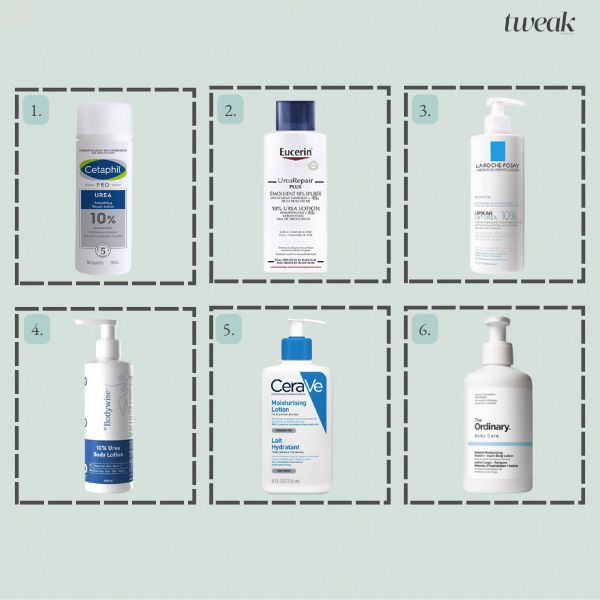
1) Cetaphil Pro 10% Urea Smoothing Repair Lotion, ₹1,450; 2) Eucerin UreaRepair PLUS 10% Urea Lotion, ₹5,722; 3) La Roche-Posay Lipikar Lait Urea Body Lotion, ₹3,999; 4) Be Bodywise 10% Urea Body Lotion With Ceramides, ₹399; 5) CeraVe Intensive Moisturising Lotion, ₹1,250; 6) The Ordinary Natural Moisturizing Factors + Inulin Body Lotion, ₹1,500
Double down on its benefits
Urea is a triple-duty powerhouse by itself, but pairing it with certain skincare ingredients can boost its hydrating and exfoliating benefits even further. “Urea pairs well with hydrating agents such as glycerin, hyaluronic acid, and allantoin to treat very dry skin. It also works synergistically with ceramides to restore and strengthen the skin barrier. To boost its exfoliating effects, combine urea with lactic acid. It’s super effective to improve rough skin texture without irritation,” says Dr Sharad.
What to be cautious with is over-layering. “Formulations containing higher concentrations of urea should be used cautiously when combined with strong exfoliating agents such as glycolic acid or retinoids, as this may increase the risk of skin irritation,” warns Dr Sharad.