

“It’s like one step forward, two steps back”
Indian filmmakers and actors discuss the O’Womaniya! report’s fifth edition
In a decade of filmmaking, actor Bhumi Pednekkar says she has seen only one woman-led crew. Just one.
That’s not a throwaway statistic; it’s a decade of sets and departments headed almost entirely by men with one solitary exception. Let it sit with you for a few seconds before we get to the numbers, because that’s where it gets more striking.
Prime Video India recently released a new edition of the O Womaniya! Report and hosted a roundtable discussion on their findings. The report is an ongoing study that has been tracking gender disparity in the Indian entertainment industry since 2020. Researched and curated by Ormax Media, a consulting firm that forecasts various film and media trends, and produced by Film Companion Studios, the report analysed 122 films across 9 languages released in 2024, eventually bringing together actors, filmmakers, and producers to interrogate what the data actually means.
The conversation that followed was equal parts illuminating and uncomfortable, which is exactly the point.
“Women not going to the theatre is not a disease. It’s a symptom.”
It’s the most observant statement from the roundtable that came from filmmaker Rahul Ravindran, who arrived at this thought while pushing for his film The Girlfriend (2025) to get a theatrical release.
He maps out the logic that the industry keeps getting backwards: fewer women in theatre audiences results in fewer female stories being greenlit. This means even fewer women are showing up to watch films. It’s not that women don’t want to go to the movies. It’s that the movies don’t particularly speak to them.
Filmmaker Shazia Iqbal adds context, “The theatrical audience was always male; women don’t step out to go alone to the movies. There’s definitely a change if you compare what the industry was like 20 years ago, but since COVID, there’s been a decline in female audience going to the theatres, leading to a lot of big releases reserved for hyper-masculine films with male-dominated audience in mind and leaving mid-budget films to streaming platforms.”
The result? Women, as both storytellers and audiences, end up on the smaller screen. Not because that’s where they belong, but because that’s what the cycle keeps producing.
The numbers are moving in the wrong direction
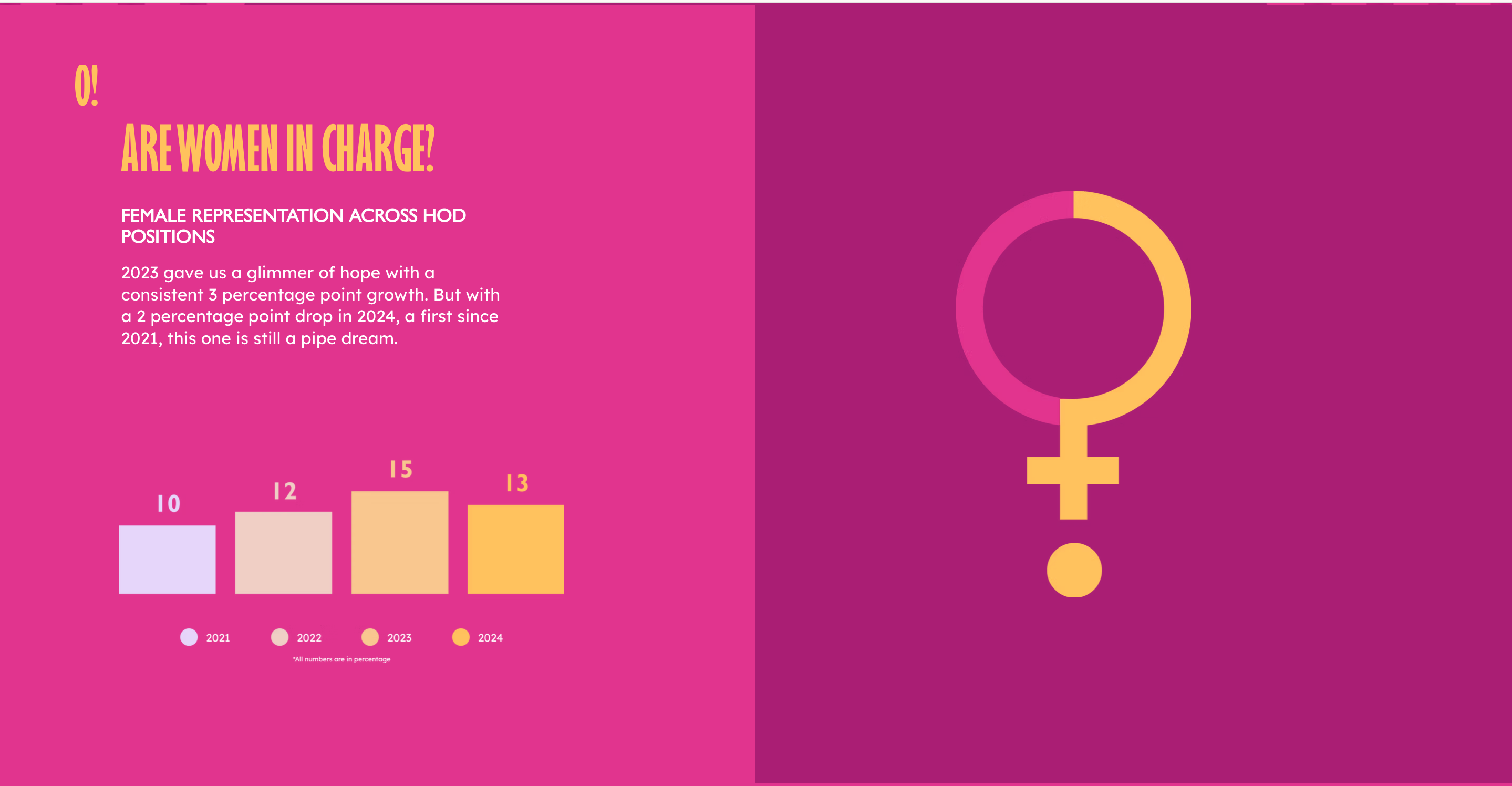
According to the report, in 2023, 15% of Head of Department positions in films and series were occupied by women. In 2024, that number dropped to 13%.

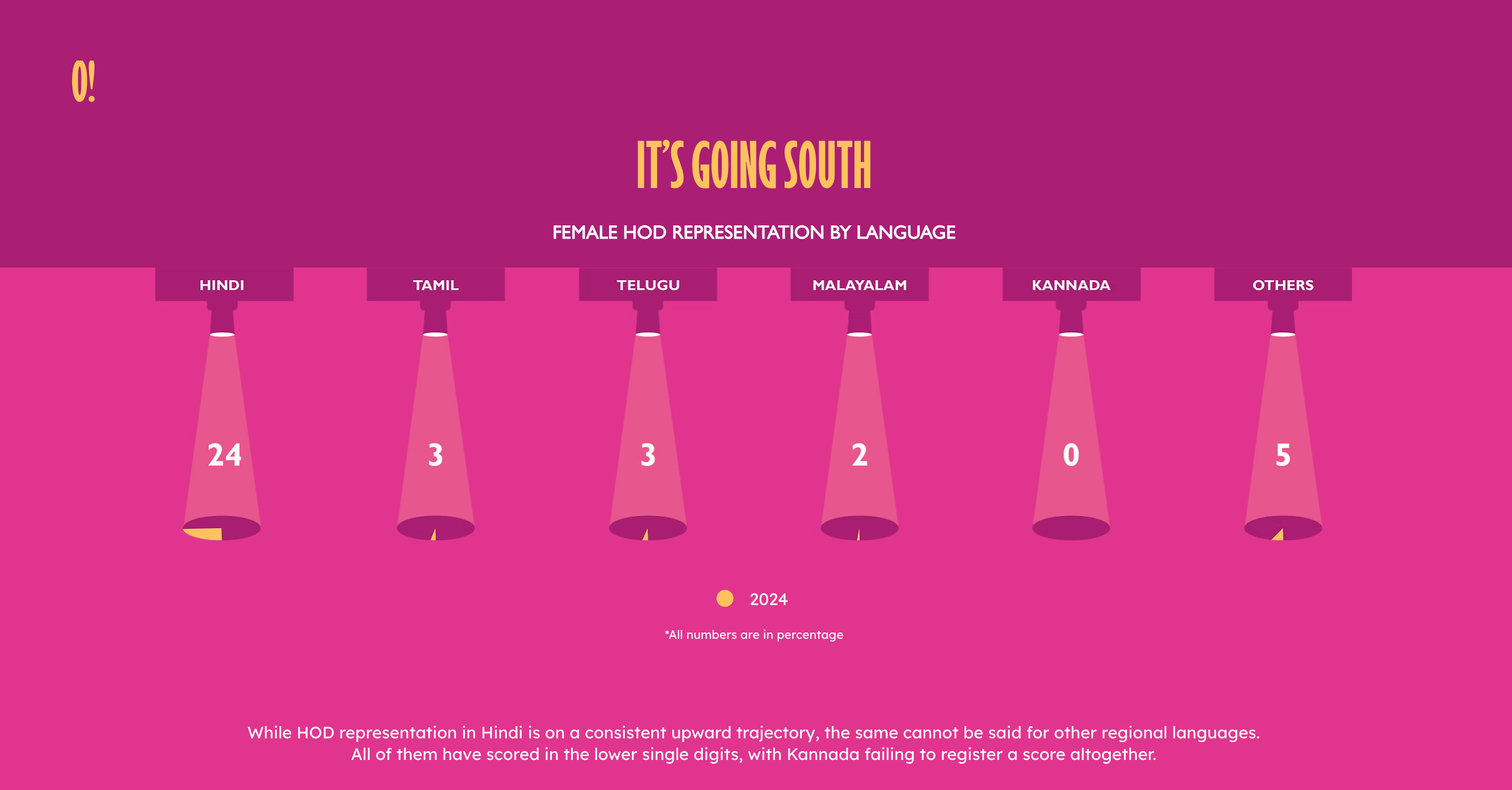
Across languages, Hindi films lead with 24% of HoD positions held by women, barely a quarter. While Kannada films currently report little to no women in HOD roles at all.

Rahul Ravindran points to something deeper. He says, “The problem is even deeper than that. It is a societal problem rather than just a cinema problem, where, for several reasons, women aren’t encouraged to pursue learning technical skills in cinema, be it for editing or cinematography.”
Stuti Ramachandra, director and head of production and post, international originals at Prime Video India, offers a practical fix: “As a filmmaker, you have to make a conscious effort to instruct current HODs that incoming assistants and incoming junior crew should pick from boys and girls equally. Because it’s only when you get production assistants and editor assistants who are girls, that some will [grow to hold] HOD positions later on.”
It sounds simple. The fact that it needs to be said out loud, at a roundtable, in 2026, tells you everything.
The debut director problem nobody talks about
This is where producer and CEO of Sikhya Entertainment, and founder and CEO of Women in Film, Guneet Monga Kapoor, says the quiet part loud: “Specifically, new male directors, when they have to make their first films, hire female DoPs and editors. A lot of the first films, all the difficult and even unsafe work is handled by female DoPs. They make do with the lack of money and equipment; they come fueled by passion. But once the director makes it big, they switch to the more shiny name in town.”
And this matters for what ends up on screen. The O’Womaniya Toolkit — an institutionalised test similar to the Bechdel test — measured female representation across 115 films and series. Only 37 passed. The criteria: do the women in the film have agency, developed plot lines, or are they simply accessories to a male character’s larger story?
Streaming films had a higher pass rate at 47%, and theatrical films came in at 19%. The screen that takes women less seriously is also the one that gets the biggest budgets and the widest audiences.

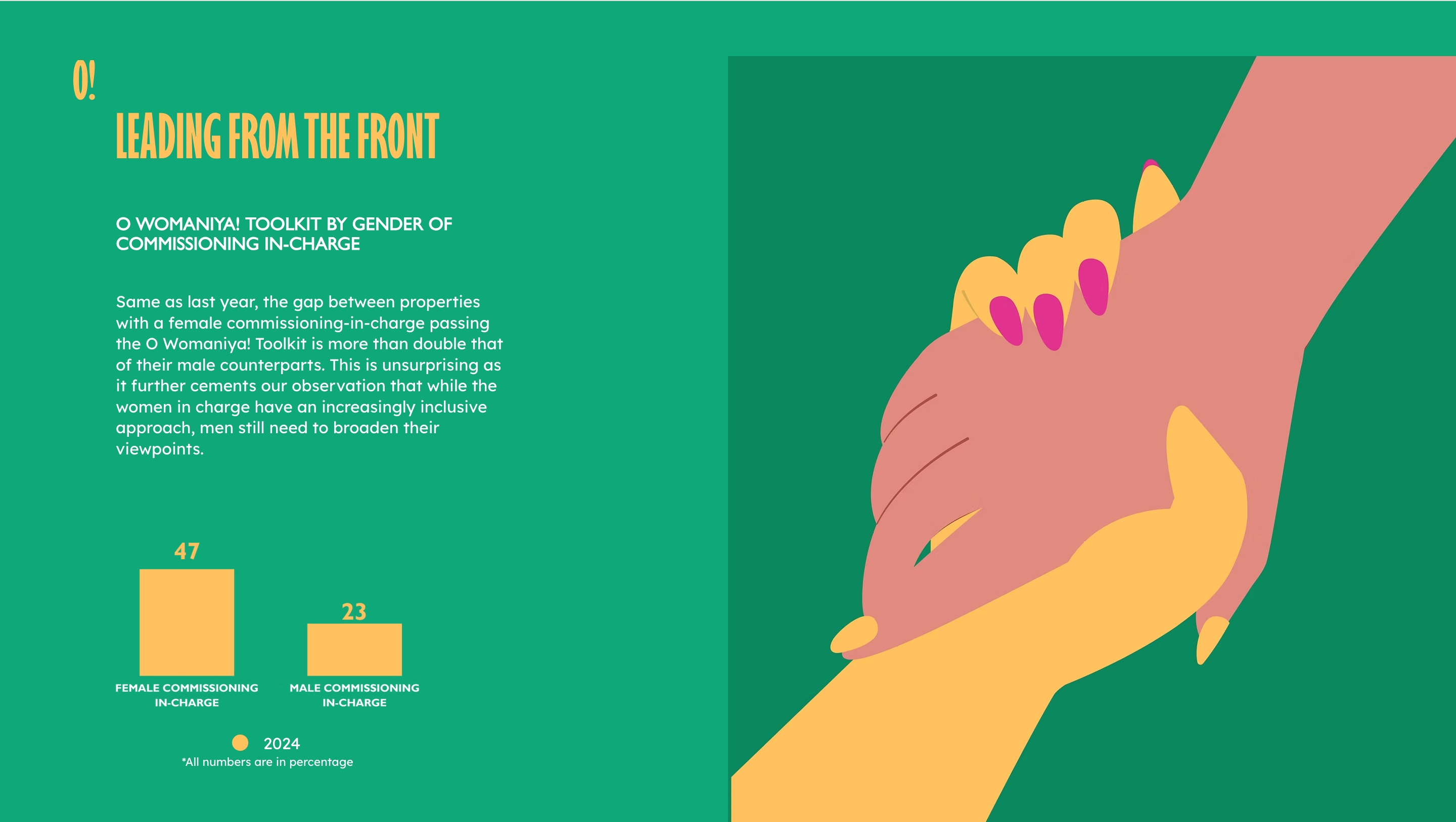
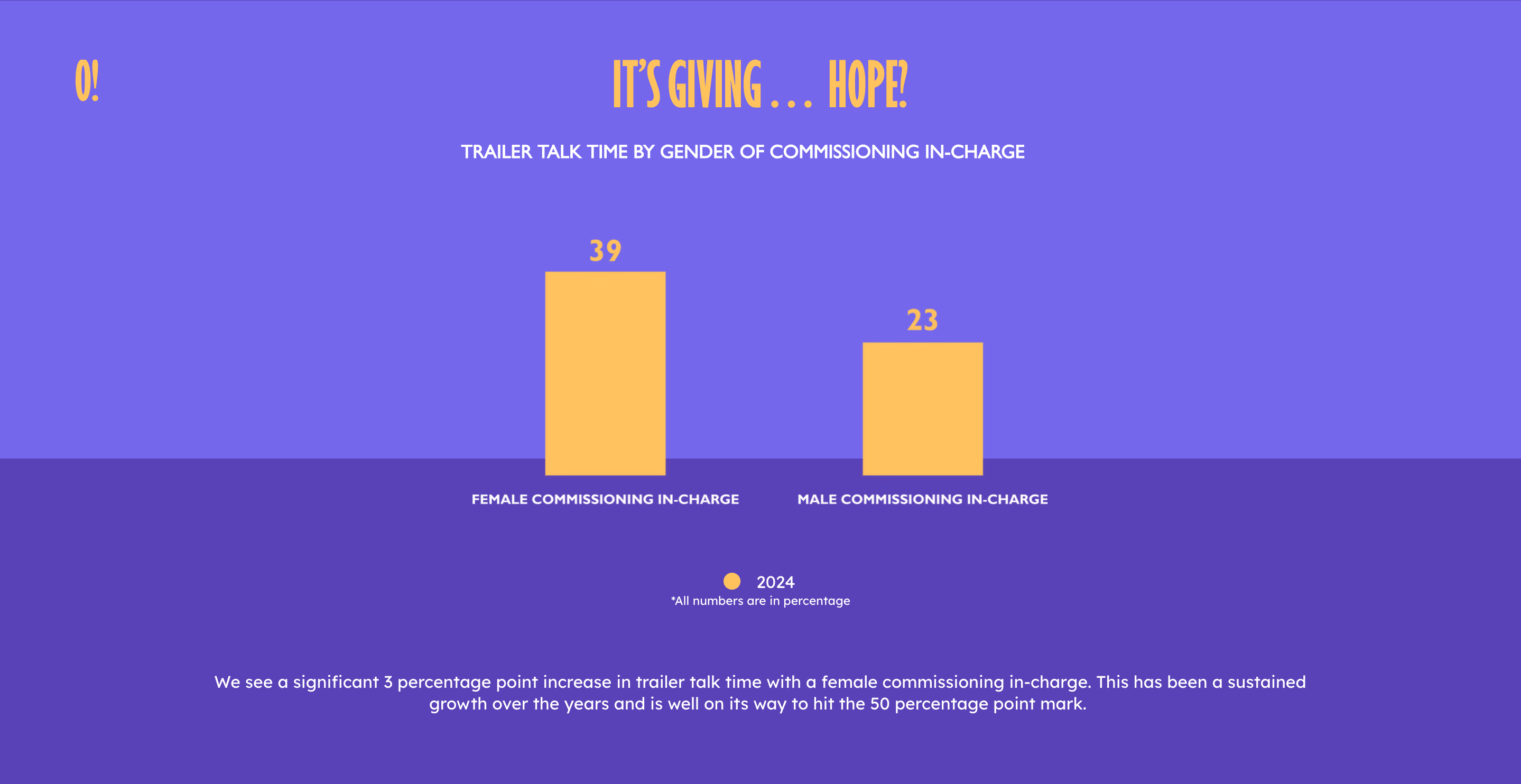
The data also shows that when women are in charge, things change behind the scenes and on screen. Female-commissioned projects give women comparatively more screen time, even in trailers. The instinct to tell more inclusive stories isn’t a mandate or a quota. It appears, quite simply, to be what happens when women are in the room.

There’s a catch
Even a 50% female crew doesn’t automatically fix the problem. Gender roles still dictate which jobs women are hired for, like production design, hair, makeup and costume. The heavy-duty storytelling roles, the camera, and the editing suite largely remain in men’s hands.
This is the difference between diversity as optics and diversity as infrastructure. Having women on set matters. Having women in positions that shape the story is what changes the film.
Why this report exists
Think about what happened when women’s cricket took over the headlines. Suddenly, little girls and women across the country had someone to point at and say, that could be me. The same logic applies to films, where more women behind the camera, in the writer’s room, at the producer’s table, means more kinds of stories. It gives women the chance to finally graduate from being the audience to being the architects.
This report lays out the unglamorous numbers about the spaces where women are conspicuously needed and yet kept outside. It starts as data points, but these conversations can lead to something far more interesting. That’s exactly where O’Womaniya steps in with the right questions.
The O’Womaniya report, researched by Ormax Media in partnership with Film Companion Studios, analyses gender representation across Indian cinema and streaming. The 2024 edition examined 122 films across 9 languages.