

Good news, you're no longer sentenced to writer's block
6 bestselling authors give writing advice they took themselves
If you’re a writer, chances are, you’re stuck in an endless loop of waiting for the perfect opportunity to pen down a first draft. Restlessly biding your time for a quiet morning with no distractions, for your coffee to be just the right amount of bitter, for a shred of life-changing writing advice to land up at your doorstep, and for a flash of inspiration where everything suddenly clicks into place.
But, writing isn’t a rare gift you’re granted in a serendipitous moment. In fact, it’s not a gift at all. Think of it as learning to prepare a delicious meal. At first, you scramble to find a reliable recipe (why not try one of these easy hacks), add spices with a hesitant hand, overcook the food, and scorch the non-stick pan. But, with time, patience, and consistent effort, you’re able to season your meals to perfection and whip up complex recipes that elicit lip smacks and impressed grins. Much like cooking, writing is a craft that can be honed and perfected over time.
This means that you can’t just rub Aladdin’s magic lamp and ask a bearded genie to grant you the inspiration and literary prowess you desire, whenever you desire it. What you can do, though, is make a diligent effort to befriend the writing process, to enjoy the peaks and plateaus. So, whether you’re a wide-eyed novice, a burnt-out wordsmith, or just someone who wants to pick up a new hobby, we’ve rounded up practical and self-tested writing advice from Tweak Book Club’s conversations with bestselling authors to help you get into the groove.
Writing advice from those who’ve been there and done it
Your day job is the real MVP: Abraham Verghese
Almost every aspiring writer has at some point dreamed of quitting their day job and absconding to a rustic cabin in the woods to write to their heart’s content. There’s something enticing about the idea of putting words to paper while being cut off from the outside world. American musician Justin Vernon travelled to a remote cabin in Wisconsin to focus on writing his hugely acclaimed album, For Emma, Forever Ago. Closer home, Ruskin Bond (here are some books reminiscent of his work), too, paints a vivid picture of a slow life in the mountains, where leisure time is abundant and writing always takes centre stage.
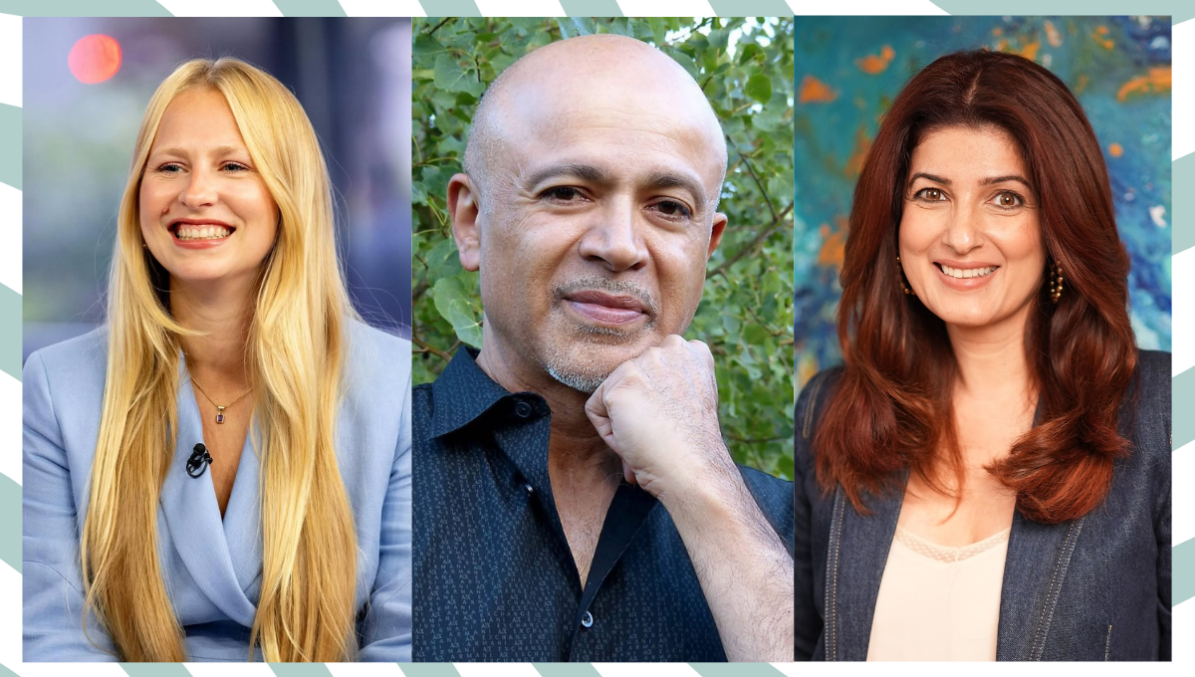
But, while it may be tempting to embrace writing as a full-time career, American author Abraham Verghese, known for his vivid and immersive storytelling in the multi-generational family saga, The Covenant of Water (2023), is convinced that there’s nothing worse than trying to pay your bills through your writing. “I could have never made a living on my writing, it would’ve been such a struggle,” says the physician who is also a tenured professor at Stanford University. The depressing truth about the publishing industry is that unless you’re a celebrity author with additional sources of income, like panel discussions or brand partnerships, you probably won’t make a living off royalties. “Having the security of a day job that I love gave me the freedom to work on [writing]. Also, to be free of the urgency that makes you take shortcuts and do things that you shouldn’t do if you’re being true to the story,” he adds.
Watch Tweak Book Club’s conversation with Abraham Verghese here
The voice in your head is your first editor: Chris Whitaker
To nobody’s surprise, most writers tend to get caught up in a rat race of meeting deadlines and complying with readers’ and editors’ demands. In the process, you often forget to check in with the one person that truly matters the most: yourself. British author Chris Whitaker—acclaimed for his poetic style and well-drawn characters in the thriller cum love story, All The Colours Of The Dark (2024)—echoes this sentiment. “Ten years ago, my agent said to me, if you’re not enjoying it, you’re doing something wrong. And that kind of stuck with me,” he says. So, amidst the chaos, be sure to touch base with yourself every once in a while and ascertain if you’re enjoying your own work.
He maintains that it’s important to be brutally honest with yourself. “Just have faith and really trust your gut feeling. Is this the absolute best I can do? Is this the best possible sentence? Is this the best paragraph? Could I not change a single word in this paragraph? It’s only when the answer is ‘yes’ to that question, that I move on to the next scene,” he says.
Watch a snippet of our book club conversation with Chris Whitaker here
Your terrible first draft will set you free: Twinkle Khanna
It’s no secret that self-doubt is the bane of every writer’s existence. But if you’re tired of the nagging voice in your brain that starts spewing vitriol as soon as you start writing, your best bet might be to just push through it. Bestselling Indian author Twinkle Khanna, (Welcome to Paradise, 2023), believes that you need to force yourself to write your first draft, irrespective of how bad you think it is.
Khanna, famous for her razor-sharp wit and keen observations, says, “I tell myself that my first draft is just regurgitated vomit. I just have to get it onto the page and then I’ll fix it later. If you have enough words on the page, you can fix it. But, if you have nothing, what will you fix?” So, if you’re anxious and wondering if there has ever lived a worse writer than you as your fingers fly across the keyboard getting that first draft out, good news – you have more in common with literary giants than you think.
Watch Twinkle Khanna talk about her writing process here


A lone fox can get lost; look for your pack: Coco Mellors
When you think of a writer, you’re bound to imagine a solitary creature, hunched over a crumpled manuscript, resentful of the visitor who comes knocking at their door unannounced. While this may be a farcical stereotype, we can’t deny that there’s something inherently reclusive about being a writer. In fact, many literary greats, including JK Rowling, Agatha Christie, Charlotte Brontë and William Shakespeare, have been known to be introverts. Besides, the work ultimately does actually require you to step away from the madding crowd and sit down to write.
But, while an ability for solitude is necessary, being part of a community is as crucial. British author Coco Mellors—whose sophomore fiction, Blue Sisters (2024) is a poignant portrait of sisterhood, grief, and love—is a huge supporter of writing groups and workshops. “I think that deadlines, community, encouragement, criticism, praise, all of these things are hugely important to writers,” she says when asked to share her writing advice for budding authors. So, if you’re battling a creative block, need some writing advice, or are just eager to start afresh, she believes it’s a good idea to sign up for an online class or start a writing group with friends. “Just meet up every few weeks and share your pages. I actually wrote both my first two novels in writing groups,” she adds.
Watch a snippet of our conversation with Coco Mellors here
Nobody cares until you make them: Devdutt Pattanaik
After spending an excruciatingly long time crafting a story, it’s normal to expect that your readers will respond to it with passion and enthusiasm to match your own…until they don’t, and you’re left feeling betrayed and resentful. If this is you, and you frequently find yourself dejected because your work hasn’t struck a chord with your audience, you may want to hear some brutally honest writing advice from Indian author and mythologist Devdutt Pattanaik, who’s known for his interpretations of ancient Indian scriptures into modern-day page-turners (My Gita, 2015; Sati Savitri, 2024).
He says, “Ask yourself why anyone would want to read your book. Nobody is obliged to read it. You have to work with the fact that people are not interested in your story or subject. And then, your brain starts working differently.” He also goes on to explain that you don’t write in a vacuum—far removed from all of society—you write for other people. So, once you’ve written the first draft of your dreams, take a break and then come back to it with your reader’s hat on. Does it still work well? Does it need to be more accessible, less dense, more complex? You now have a direction.
Watch our conversation with Devdutt Pattanaik here
Experiment with a khichdi of techniques: Parini Shroff
Much like books, writers too, come in all shapes and sizes. While some are inspired by quirks of the people they encounter on a daily basis, others prefer to write about far-off lands and mythical creatures. While some are open to spontaneous ideas, others won’t begin writing until they have read every last available source on their subject. So, it’s safe to say that there’s no one-size-fits-all writing advice to getting it done. According to Parini Shroff, the author of the funny, feel-good fiction, The Bandit Queens (2023), you may just need to try a bunch of techniques to figure out what actually works best for you.
“For some people, it’s a question of getting your butt in the chair and getting through it, even if you’re not writing any words, just sitting and staring. For other people, the solution is getting out, observing, filling up the well that has dried, so you can begin again. So, I think you have to just try it all and see what works for you,” she says. The only writing advice you truly need is to stay open and non-judgemental of what the process teaches you about your own writing peccadilloes – who knows, you might be famous for them one day.
Watch a snippet of the conversation with Parini Shroff here