


"After fighting so much to play, I can’t let challenges discourage me": Footballer Ashalata Devi
In our series Leading Ladies, we profile change-makers whose pursuit of excellence and challenging of conventions has inspired many to speak their minds
You know how in most neighbourhoods, whether the ground turns muddy after the rain or weeds grow all year round, there’s always a bunch of kids who show up with a ball, dirty shoes, and high spirits? That’s the kind of passion 32-year-old Loitongbam Ashalata Devi, the captain of the Indian women’s football team, still has for the game—20 years after her journey began.
Which is remarkable, especially when you consider how little India seems to value women’s football. In 2025, in a historic hat-trick, India’s senior, U20 and U17 national teams all qualified for the AFC Women’s Asian Cup. Still, the 2025-26 Indian Women’s League (the country’s main domestic tournament) that took place just last month, went largely unnoticed, unlike the IPL and WPL, the only domestic leagues most of us know of.
The sport has survived on little more than the stubborn hope of its players, who have for long been campaigning for better infrastructure, opportunities and attention. In 2022, the All India Football Federation (AIFF) announced a plan to systematically strengthen women’s football in India and improve its international rankings. Yet even today, the attention the game receives, remains limited.
Amidst these systemic shortcomings, Ashalata managed to build a stellar career worthy of the captain’s armband, and continues to register many record firsts for India. She led the national team to the second round of Olympic qualifiers in 2018 (for 2020 Tokyo Olympics), and in October 2024, became the first Indian woman to play 100 international football matches.
Maybe it is her unyielding optimism that carries her through. “We have been giving our best and seen some good results recently. So I can only hope that the next generation of players gets better resources and opportunities,” the Imphal native tells Tweak over a Zoom call.

The girl who rebelled
In school, Ashalata saw only boys playing football, and it didn’t sit well with her. At the age of 13, she finally asked the sports teacher to let her play. “He told me I would have to form a team to be able to play. So I convinced my friends, we formed a team, and started playing the very next day. Eventually, more girls began joining us,” she recalls.
But many of the girls left just as quickly as they had joined. The reason? Societal pressure. “Where I come from, people had never seen girls play football. Their families didn’t allow them. And for many, playing also meant compromising on their education.”
Ashalata’s family was no different. Her parents were against her playing from the get-go. But she persisted, eventually enrolling in professional training at a centre almost an hour away from home. “My mom would yell at me every time I returned from training. But my uncle (my father’s younger brother) loved the game and supported me. He was the one who bought me all my equipment,” she says.
In 2008, at the age of 15, she finally received a call for the India U17 women’s team, which marked the beginning of her professional football career.
Does she think it has become easier for girls who want to pursue the sport today? “I do see changes,” Ashalata says. “I recently organised a five-day football festival in Manipur, where I saw parents dropping off their kids themselves. When you love something as a child, your parents’ support and blessings matter the most. It was heartening to see the change in perception.”
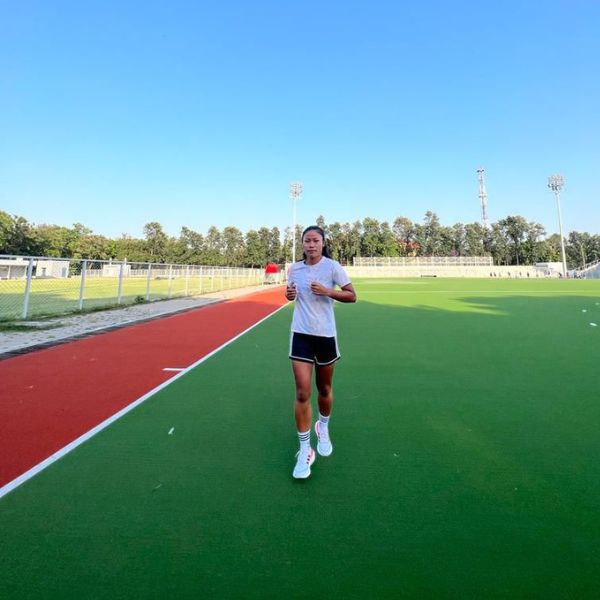
A day in her life
“If I tell you my training schedule, you’ll not believe that I am a professional footballer,” says Ashalata who is an Indian Railways employee (currently stationed in Bihar) by day. “When there are no national team tournaments or Railways matches, we are required to spend a full eight hours at work, which makes it difficult to train properly,” she explains.
Yet she manages somehow. Her days begin with two hours of football practice in the morning, followed by office from 10am to 6pm, and then a two-hour gym session post-work. “The routine is very demanding. Most days, by the time I reach home, I have no energy left to think of anything else.”
The only relief comes on Sundays, when she can take some time out for herself—maybe go to a mall or a cafe. The schedule, of course, changes during tournaments.
“We get our jobs through the sports quota, but we are professional athletes. Nobody realises the challenges of having to train while working full-time. We want to train more and perform better, so there’s a need to find a solution,” she says.

The fire that keeps burning
Whenever the odds have been stacked against her, Ashalata has defied them (just like this ultramarathon runner). Where does she find the strength and grit? “I have been through a lot during the beginning of my career, especially as I went against my parents’ wishes. I have been injured and bounced back. Whenever I am in a difficult situation, I tell myself that I haven’t come this far to only make it this far. After fighting so much to play, I can’t let challenges discourage me and let all my hard work go to waste,” she says.
Ashalata paved a way for herself, but doesn’t intend to stop there. She now wants to do the same for young girls who dream of becoming professional footballers. “I want to open a football academy in my hometown,” she reveals. “Girls there have to travel long distances to get proper training, which makes them give up on their studies. I don’t want that to happen.”
The centre-back is of the firm belief that education and sports should go hand-in-hand. “Not every player ends up playing professionally. And for those who do, they still need education to have better options after retirement. So, with my football academy, my goal will be to guide young players to not compromise on either,” she says. “I want to create opportunities for them that I didn’t have growing up.”
*This interview was conducted in Hindi and has been translated into English. Some sentences have been paraphrased for clarity.