


Are you being catfished by your sunscreen?
We decode the confusion
There’s been serious talk in the Indian skincare world lately after a viral creator claimed that six out of ten popular sunscreens don’t deliver on their SPF promises. Suddenly, what was once a humble morning habit became a national skincare crisis. WhatsApp groups were forwarding SPF theories faster than election memes. Can we trust the tube on our vanity? Should we toss it out and hide indoors forever? Or worse, stop using sunscreen altogether?
Before you resign yourself to a life under hats and umbrellas, here’s the truth dermatologists agree on: sunscreen is still your skin’s best defence. Cricketers had it figured out way before we did. Remember Anil Kumble and Andrew Symonds taking to the field with white streaks across their lips and faces? We thought it was war paint. Turns out, they were protecting their wicket and their skin.
But not all sunscreens (or viral claims) are created equal. We spoke to formulators, dermatologists, and R&D experts to decode what’s really happening inside (and on) the tubes —from how SPF is tested to what those confusing labels mean, and how to actually use it right.
Decoding your labels: SPF, PA, and what they really mean
Before you toss out your sunscreen in panic, it’s worth understanding what it actually does. Sunscreen protects your skin from the sun’s ultraviolet (UV) radiation, mainly UVA and UVB rays. Both are harmful, but in different ways. “UVA (Ultraviolet A) rays are the kind that cause premature ageing. They penetrate deep into the dermis and are responsible for fine lines, long-term cellular damage and sometimes even skin cancer,” says Dr Kiran Sethi, dermatologist and founder of Isya Aesthetics in New Delhi. They’re also stealthy; UVA rays can pass through glass and clouds, meaning you’re still exposed even when you’re indoors or driving. “UVB (Ultraviolet B) rays, on the other hand, are the kind that cause tanning and pigmentation,” says Sethi. They affect the skin’s top layer, causing redness, inflammation and sunburn. Over time, both UVA and UVB exposure can contribute to premature ageing and increase the risk of skin cancers.
That’s where SPF and PA ratings come in. They’re the two cryptic codes on your tube that tell you how well your sunscreen is working. SPF stands for Sun Protection Factor and measures how effectively a sunscreen protects against UVB rays. For example, SPF 30 allows about 1/30th of UVB rays to reach your skin, while SPF 50 allows 1/50th. “In practice, an SPF 30 would protect you from roughly 97% of UVB rays when applied correctly,” says Sethi. PA stands for Protection Grade and measures defence against UVA rays. It is usually rated from PA+ to PA++++ where more pluses equal more protection.
In short, SPF protects from burning, PA protects from ageing, and the label ‘broad-spectrum’ means it covers both. Think of SPF as your outer shield, but PA protection is your invisible armour for what’s within. You need both, especially in a tropical country like India, where stepping out is basically a full-contact sport with UV rays. Many modern sunscreens also go beyond just UV defence. They’re now infused with antioxidants like vitamin C, niacinamide, and green tea extract to tackle visible light and pollution damage. Because these days, protection isn’t just from the sun — it’s from screens, smog, and stress too.
Testing trouble: Why India’s sunscreens are under the microscope
Here’s where things get really interesting. Sunscreens around the world are tested in two main ways — in vitro (in the lab, using plates or synthetic membranes to measure how much UV light the formula absorbs) and in vivo (on real human skin, measuring how much protection it offers in practice).

As cosmetic chemist Dr Aneesh Sheth explains, “Both tests are done in controlled environments that don’t fully represent the real world environment. There’s also a human factor involved — how it is applied, thickness of application and how evenly it is spread. This can make results inconsistent across labs.”
India, at present, also lacks a unified national standard for sunscreen testing. According to Sapna Singh, Head of R&D at Lakmé, “Markets like the EU, LATAM, and the Middle East follow ISO (International Organization for Standardization)-standard in-vivo testing for sunscreens to ensure accuracy and consumer safety. Until recently, there was no single, unified national standard for sunscreen testing in India. Brands often relied on their own in-vitro data or mathematical simulations. That’s why SPF results could sometimes seem inconsistent when compared to global protocols.”
Dr Sheth adds, “Standards also differ based on how a product is categorised. In Japan, for example, sunscreens are treated as quasi-drugs, so testing requirements and regulations to launch one are far more stringent. In India, they’re categorised as cosmetics, which is why authorities have historically accepted in-vitro data alone.”
But here’s where we’ve been catching up. “The Bureau of Indian Standards (BIS) is now adopting a formalised protocol for in-vivo SPF testing protocol, bringing the country in line with globally recognised ISO methods. This shift brings greater transparency, scientific consistency, and credibility to sunscreen claims, marking a significant leap forward for the Indian beauty industry,” says Singh.
The change becomes official on January 10, 2026. “Unlike the earlier, more varied approaches, this standard ensures sunscreens are tested directly on human skin to reflect realistic protection levels. What’s more, these studies will account for Indian skin tones, producing data that’s locally relevant and scientifically precise. This advancement not only enhances scientific rigour and consumer safety but also ensures that sunscreen efficacy claims are credible, consistent, and suited to the needs of Indian consumers,” Singh adds.
So yes, the viral SPF tests that sparked the SPF debate may not have been wrong. But they have highlighted a deeper issue: inconsistent testing environments, not necessarily dishonest brands. The upside? India’s sunscreen scene is about to become far more transparent, scientifically standardised, and globally aligned, meaning the SPF 50 on your label will finally carry the same weight from Mumbai to Milan.
Mineral vs chemical: What’s really inside your sunscreen
At the simplest level, sunscreens rely on two types of filters to protect your skin: mineral and chemical. Mineral filters, mainly zinc oxide and titanium dioxide, act like microscopic mirrors, reflecting and scattering UV rays away from your skin. They’re gentle, great for sensitive or acne-prone types, and thanks to modern nano-particle versions, they’ve shed the chalky white look. These formulas can still feel a bit heavier on your skin.
Chemical filters, on the other hand, absorb UV rays and convert them into heat, offering a lighter, invisible finish. According to Sethi, “Mineral filters like zinc oxide and titanium dioxide are globally used and remain the backbone of Indian sunblocks. Chemical filters such as oxybenzone, octinoxate, avobenzone, and octocrylene are also very common in the Indian market.” You can also get hybrid filter sunscreens that contain both chemical and mineral filters.
Interestingly, many of the modern filters found in Korean or European sunscreens, like Tinosorb S (Bemotrizinol), Tinosorb M (Bisoctrizole), and Mexoryl SX/XL (Terephthalylidene Dicamphor Sulfonic Acid and Drometrizole Trisiloxane), are technically approved under India’s BIS IS 4707 Part 4 standards, but aren’t yet widely used in local manufacturing.
Sheth explains, “In India, formulators often use SunCat technology. It’s a water-based encapsulation system to create elegant and effective sunscreen formulas with the currently available chemical filters.” This technology encapsulates UV filters in microscopic water-based spheres, making sunscreens feel lighter, more stable, and less irritating — great for our hot and humid weather.
So what’s really doing the work? The SPF and PA or these filters? Think of it this way. The filters are the hardworking ingredients, while SPF and PA are simply the scorecards telling you how well they perform.
The two-finger rule and what to look for
When it comes to sunscreen, it’s not just what’s in the tube, it’s also how you use it. The right amount makes all the difference. Sethi recommends 2mg per square centimetre of skin. That’s roughly two full fingers for your face and neck, and about half a teaspoon for your entire body. Reapply every three to four hours, or sooner if you’re sweating, swimming, or simply out in the sun.
In our climate, gel or water-based chemical or hybrid sunscreen formulations that feel light, non-sticky, and sweat-resistant are your best bet as they won’t clog pores. What you’re looking for on your labels is SPF 30 to 50, broad-spectrum protection, and PA+++ or higher for daily use. And since UVA rays penetrate glass and clouds, overcast skies or air-conditioned offices cannot be your get-out-of-SPF-free card. You might not tan visibly, but cellular damage is still happening underneath. Screen exposure doesn’t help either. If your daily routine mostly unfolds under artificial light, opt for tinted sunblocks. “The iron oxides in them help protect against blue light and visible light from screens and LEDs,” says Sethi.
She also warns against relying solely on makeup or tinted moisturisers with SPF. Most people apply only one-fourth to one-third of the recommended sunscreen amount through these, just enough for colour coverage. “That means your effective SPF is only around 5–10, even if the label says SPF 30 or 50,” explains Sethi. “You’d need at least two to three layers of makeup to get enough protection, which no one’s actually doing.”
Her advice? “Use a proper sunscreen in the right quantity first, then layer a tinted SPF or foundation with SPF on top. Even one layer of makeup works beautifully then.”
If your skin tends to sting, burn, or break out after sunscreen, it’s a sign to switch, not skip. Dermatologists suggest looking for fragrance-free, alcohol-free, mineral-based sunscreens. These are less likely to irritate or clog pores. Avoid formulas with high alcohol content, added fragrance, or heavy silicones. And if you’re starting a new sunscreen, patch-test first, especially if you’re using active ingredients like retinol or AHAs in your routine.
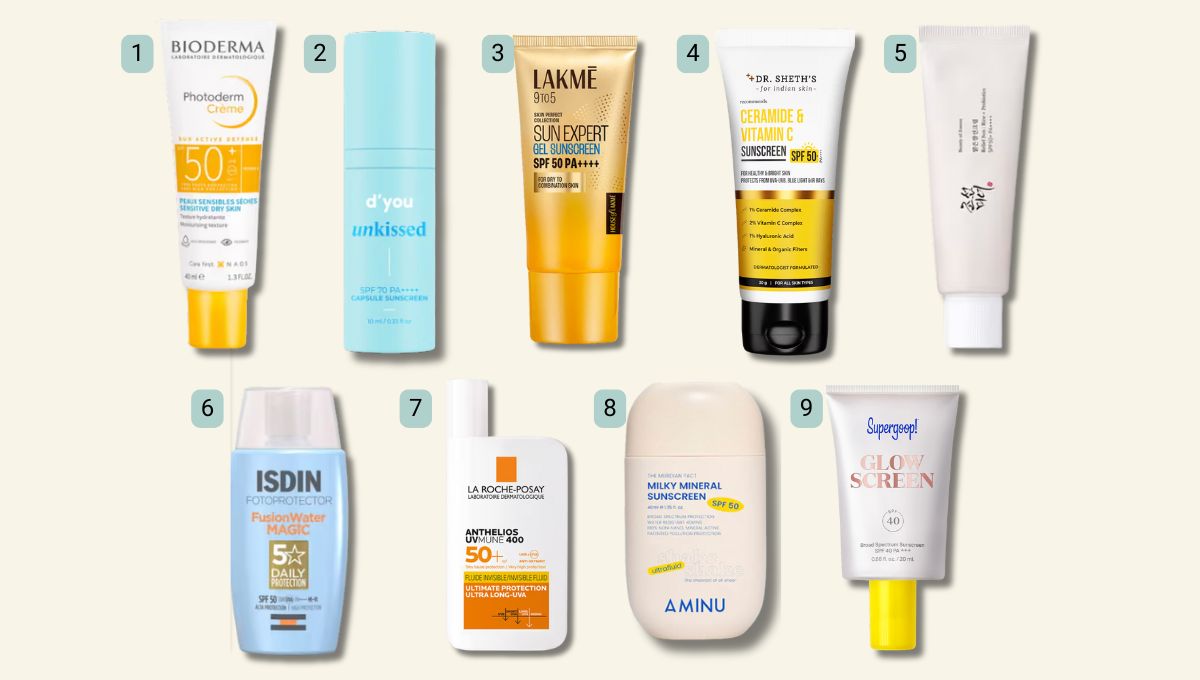
Our SPF favourites: 1) Bioderma Photoderm Aquafluide, ₹1,699; 2) d’you Unkissed, ₹2,200 ; 3) Lakme Sun Expert Gel Sunscreen, ₹369; 4) Dr. Sheths Ceramide & Vitamin C Sunscreen, ₹299; 5) Beauty Of Joseon Relief Sunscreen Rice + Probiotics, ₹1,500; 6) Isdin Fotoprotector, ₹2,590; 7) La Roche Posay Anthelios UVMune 400, ₹1,400; 8) Aminu Milky Mineral Sunscreen, ₹2,800; 9) Supergoop Glow Screen, ₹1,850
Think of sunscreen as the one non-negotiable in your skincare arsenal. It might be invisible, reliable, and quietly hard-working. Apply it generously, reapply often, and consider it skin insurance—the most effective anti-ageing step you’ll ever take.