



Whale poop is saving the world from climate change
Can you imagine your job being about collecting animal poop
If you were a blue whale, you wouldn’t need to use soggy paper straws or curtail your Zara hauls in order to contribute to saving the environment. You’d just need to take a massive dump, and it would help the Earth keep cool. In her new children’s science non-fiction work, The Big Book of Wild Poop, author Shweta Taneja unearths the magical and myriad functions of scat in the animal kingdom.
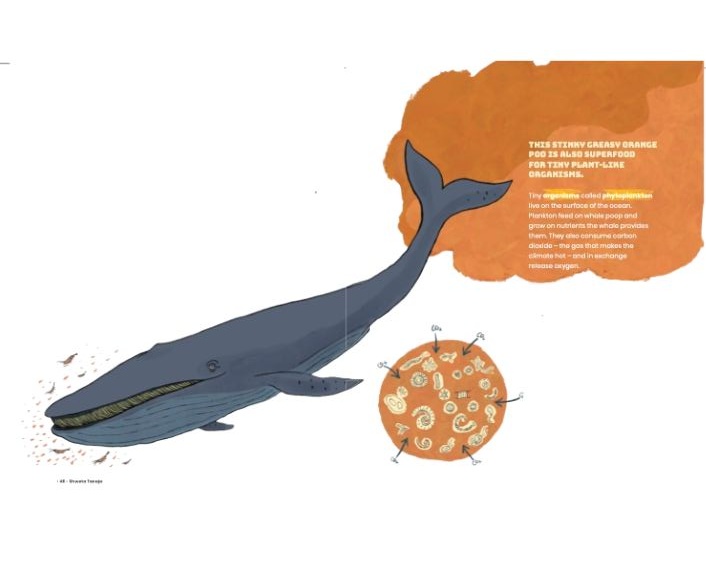
A dreamy illustration of a blue whale with orange clouds around it, turns out, is a picture of the great creature moving its bowels. And that greasy aura is actually food for phytoplankton, an organism that consumes 1/3rd of the atmospheric carbon dioxide (a greenhouse gas) and releases oxygen in return.
Taneja, a New-Delhi-based multidisciplinary writer, was approached to write this book by the World Wildlife Fund (WWF) and Indian Pitta Books, as a way to encourage children to learn about wildlife and nature. A quite effective method, too, because if there’s one demographic that finds poop endlessly entertaining, it’s children.

Facing facts with humour
Taneja’s brief was simple: write about poop, and make sure kids love it.
It isn’t easy to keep a child’s attention long enough to read a book these days, with the sheer number of digital distractions available at the mere press of a button. And a non-fiction science book about the environment, for children older than 7 years old? A real challenge.
Taneja believes that humour is the connecting bridge children need to be able to play and engage with the material well. “There are not enough humour writers in science books,” she says. “Even for children, they tend to have a slightly factual and serious-ish tone.”
She knew she would have to lean heavily on evocative illustrations and an engaging interactive format, but also jokes and her large repository of poop puns to reel in attention.
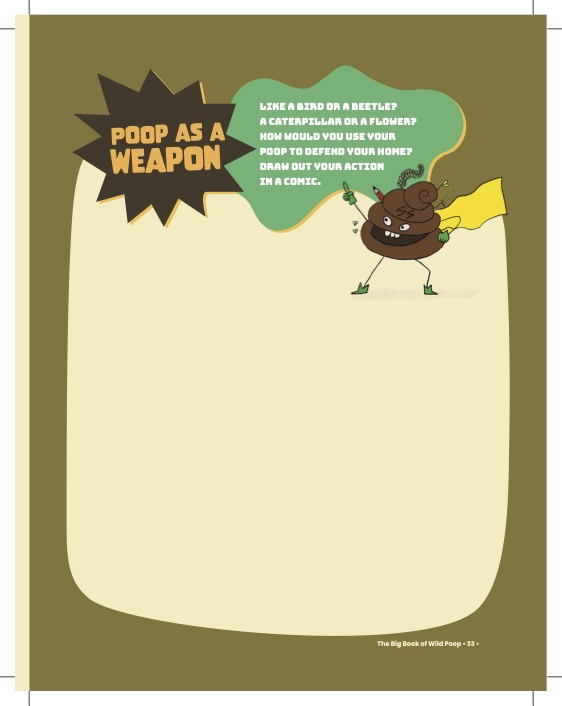
The book is a collection of standalone chapters, each reading like a story with reflective breaks in the form of quizzes, visual summaries and humorous activity prompts. At the end of chapter 4, for instance, readers are encouraged to draw a comic using poop as a weapon, just as the warty leaf beetle does.
Taneja also included silly characters, such as the recurring SuperScat, whose superpower is poop puns, shares humorous anecdotes just like children, and is supportive in learning. Like in chapter three, you see SuperScat adoring two rhinos bonding over their excretions, saying, “What a scraptivating shower of love.”

Getting shit done
When asked why she thinks she was approached for this particular project, Taneja laughs and says, “I feel like I am always writing and exploring the weirdnesses and the edges of society, whether it’s in mythology [The Skull Rosary], in fantasy [Anantya Tantrist Mystery series] or in science fiction [They Found What?/ They Made What?]—the things that we don’t talk about, the things we are embarrassed about, the things we are scared of talking about.”
Thanks to her former job at the Nature Conservation Foundation, Taneja was able to access a network of ecologists to help with research for the book. “The thing about scientists is that they love talking about their work,” she laughs. “Bibi [ecologist Bibidishananda Basu] even sent me 30 to 40 photos of tiger poop that he had collected!”
At just 70 pages, the book covers poop-stories of a whopping 90 species. Taneja says she herself was surprised at the volume of facts she was ultimately able to fit in.
“In a children’s book, every word you put on the page counts; you have minimal space and children lose interest fast. So it was difficult and required constant editing, but it sharpened my writing skills.”
Did any of the poop facts gross her out? It’s back to the blue whale. “There was a scientist whose blog I read, and he was saying how whale poops are the smelliest, oiliest, craziest thing you smell. And that kind of stuck with me.”

Serious matters in silly packaging
Elephants also help the Earth cool down like whales. They feed on the fruits and leaves of big trees that block natural sunlight for smaller plants. And as they go, they offload those seeds as well as provide enough fertiliser for new plants to grow, which in turn add more oxygen to the atmosphere.
In demonstrating how animals continue to contribute to helping ecosystems stay alive, The Big Book of Poop subtly reminds readers of their own responsibility to keep that balance. And that learning happens when we engage with our environment, keep a lookout and ask questions.
As climate change becomes irreversible, works like this that engage, entertain and sensitise younger generations to the majesty of the natural world, offer a speck of hope and an antidote to despair. We may be in deep shit, but that’s where we’ll also find answers.
‘The Big Poop of Wild Poop’ by Shweta Taneja (author) and Sunaina Coelho (illustrator) is ₹499