


This director thinks AI needs stricter parenting
Aranya Sahay’s new film makes a strong case for it
Over the past few years, artificial intelligence (AI) has tiptoed into our lives so casually that we barely notice that our day starts and ends with it. From our smartwatch analysing how well we slept, to our Netflix algorithm revealing our movie tastes through curated suggestions (people are turning to AI for therapy, too), AI has become that saccharine relative ubiquitous at all family functions, but who is not exactly well-loved. There is a strange dichotomy that surrounds AI: we can’t write a sentence without asking ChatGPT (which is not cool—take it from a writer), but at the same time, we are out there creating all kinds of useful things using the same technology.
While we marvel at the possibilities that AI brings, or debate about the ethics that surround its use, we often overlook a crucial process that powers this technology—data labelling, wherein humans tag and annotate raw data to train machine learning models to make accurate predictions and decisions.
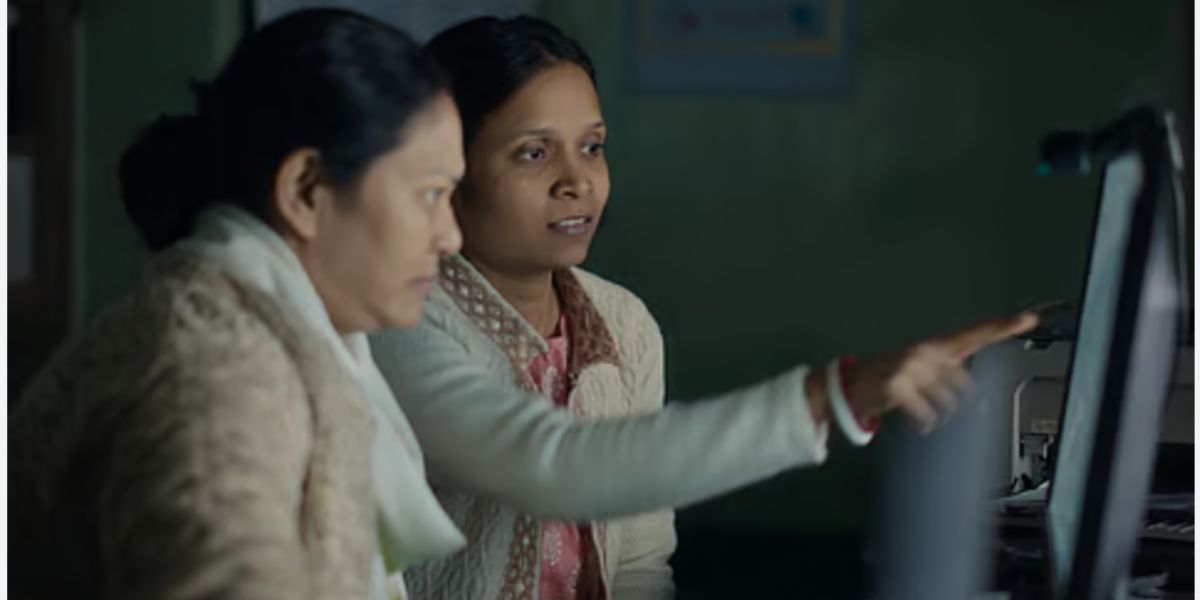
Filmmaker Aranya Sahay’s debut feature film, Humans in the Loop throws light on this aspect, highlighting how human labour shapes technology, and what it takes to train algorithms that are often biased. It follows Nehma, an Adivasi woman, who starts working at a data labelling centre in her village in Jharkhand. Through her journey of working and parenting as a single mother after her separation, the story compares training AI models to raising a child, stressing that, like children, AI will learn the wrong things if we teach it the wrong things.
The film, which blends humanity, technology and nature, recently won the ‘Best Indian Film’ title at the All Living Things Environmental Film Festival, which celebrates environmental cinema and climate stories. We caught up with Sahay, who revealed what he discovered about AI while researching for the film.
Aranya Sahay sheds light on the realities of AI
Tweak (T): Why did you choose this subject?
Aranya Sahay (AS): The premise of the film comes from a news article called ‘Human Touch’ written by journalist Karishma Mehrotra. The story throws light on the data labelling work that happens in towns and villages of states like Jharkhand and Odisha, which I thought is an important thing to spotlight. But just knowing the subject wasn’t enough. I had to work on the narrative. Finally, we arrived at the idea of viewing AI as a child, and the data labelling job replicating the act of parenting. The film explores what it means for an Adivasi mother to raise an algorithm that is primarily being raised on first-world data.

T: Can you tell us a little bit about your creative process?
AS: I have given three years to this film. After I adopted the idea, I needed to do extensive research to be able to do justice to the story. I spent a whole year in Jharkhand, researching and writing the film (before moving on to other phases like casting and production).
T: Besides ground research, did you refer to any existing pieces of literature or movies to understand the world of AI better?
AS: Of course, I read a lot of articles and research papers on the comparisons between child rearing and building AI. I read neuroscientist Anil Seth’s thoughts on whether AI can attain consciousness, and anthropologist Mary L. Gray’s research on data labelling being ghost work. There are no films that deal with these concepts directly. But I would say that there are spiritual relatives of films like mine. For example, G Aravindan’s film Kummatty gives glimpses into the intrinsic connection between humans and nature, which is also a core concept in Humans in the Loop.
T: The film highlights how AI is built through human labour, but the cultural conversation right now is also about how human life increasingly revolves around AI. Do you think AI is dependent on humans, or the other way around?
AS: It is both. We are gradually becoming dependent on half-baked algorithms. But these half-baked algorithms are actually taking shape through us.
T: The film also highlights biases in AI. Is there any particular incident that spoke to you while researching this aspect?
AS: I found several instances of AI bias during my research. Once, I came across stereotypical AI-generated images of women on the social media platform X. In those, the woman from Goa was a drunkard, the one from Bihar was a labourer, and so on. Apart from this, so many such incidents are publicly documented. For example, when Amazon automated its recruitment drive, the computer program and algorithm began giving good scores to only men because the data it was trained on was primarily centred on men.
T: There is a scene in the film where Dhaanu (the child) gets lost in the forest due to incorrect directions from Google Maps. However evolved, tech isn’t infallible, is it?
AS: That scene was based on stories I have heard, rather than any particular personal experience. Although, when I was in Jharkhand, I used to get lost all the time. Of course, technology is not infallible. The God complex in the tech world needs serious questioning.
T: What is your personal take on artificial intelligence? Is it more a boon or a threat for mankind?
AS: We can’t speak of artificial intelligence in dystopian or utopian terms. We need to view its position right now. It is neither completely evil or ‘bad’—nor really empathetic or ‘good’. We, as humans, need to take responsibility for the kind of algorithms we are building. We need to fix a lot of things; our data sets need to be a lot more diverse and representative. And of course, we need to have caveats around what kind of work we are using AI for.
T: Have you come across any strange/funny encounters with AI?
AS: Some GenAI softwares speak lies and make stuff up with such great confidence that one might actually believe them. I have gotten used to it now. I got to know that a guy once asked ChatGPT to generate a petition he could file in court. And it ended up generating clauses that didn’t even exist in law.
T: If you could ask AI to do one thing for you, what would it be?
AS: I wish AI could build a time machine, so that I could go into the future and see the condition of humankind. Are we alive or dead?