


This author did martial arts, ate platefuls of poha and drank gin with badass grannies across India
Jasreen Mayal Khanna’s new book will motivate you better than any self-help book
Ever been surprised by your own granny’s badassery? One minute you’re introducing her to a scandalous movie scene to see how she reacts, the next minute she’s telling you how she once punched a creep while walking to college in 1959?
In an ageist society like ours, it’s easy to relegate our grandmothers to the stereotypes of the sweet, servile custodian of traditional values. But if you show up with curiosity and attention, you’ll often find surprising stories of passionate, hardy women who pushed against norms.
This is how journalist and author Jasreen Mayal Khanna got the idea for her second book, Bullet Nani and Other Badass Indian Grandmas (Pan MacMillan). The book is inspired by her nani Pushpinder Kaur, who was eight months pregnant with Khanna’s mother when she left an abusive marriage. She went on to raise her daughter as a single mom, get her BEd degree, work as an English teacher.
After Kaur’s passing in 2021, Khanna spent a year thinking about the life her grandmother had managed to build for herself when women of that generation had all the odds stacked against them. She wondered if there were other grandmothers like hers, and set about looking for women of that generation who had been able to change the course of not just their own lives, but the lives of generations of their daughters to follow.
The book chronicles the stories of 12 such grannies from different corners of India, in whose lives you might find glimpses of your own nani/amammaa/baa/aaji/abok. There is the titular Bullet Nani Raminder Dhillon who faced off with the Taliban while on a UN mission in her 60s. And Thankam P., part of the first generation of female nuclear scientists, as well as Suman Dhamane, a tech-savvy content creator in her seventies better known as Aapli Aaji.
We spoke to Khanna about all the adventures she ventured on to speak to 100 grandmas across the country.


Grandmas
Tweak: You started research for this book with a simple Instagram story asking people about their grandma’s stories, but where did the idea originate?
Jasreen Mayal Khanna: I kept thinking about my grandmother’s life for an entire year after her passing. Then one day I ended up on a Reddit thread, where Indians were talking about all the wild things their grandmothers had done. All those stories had the same theme, of women standing up for themselves, and it was so similar to my nani’s journey. That was the germ of the idea—I realised that there might be more grandmothers out there, and it prompted me to put up the Instagram story.
T: What was the reaction to your story?
JMK: I had put up the story the evening before and the next morning when I woke up, I was like, what happened? Because the messages were pouring in. I had asked a few friends, influencers and NGOs to repost my story to help me get leads but I was not expecting it to go viral. That day I had to stay up till midnight, scribbling down all the names and handles because I was so worried that I would lose some of the leads. I put down almost 100 names on that Excel sheet.

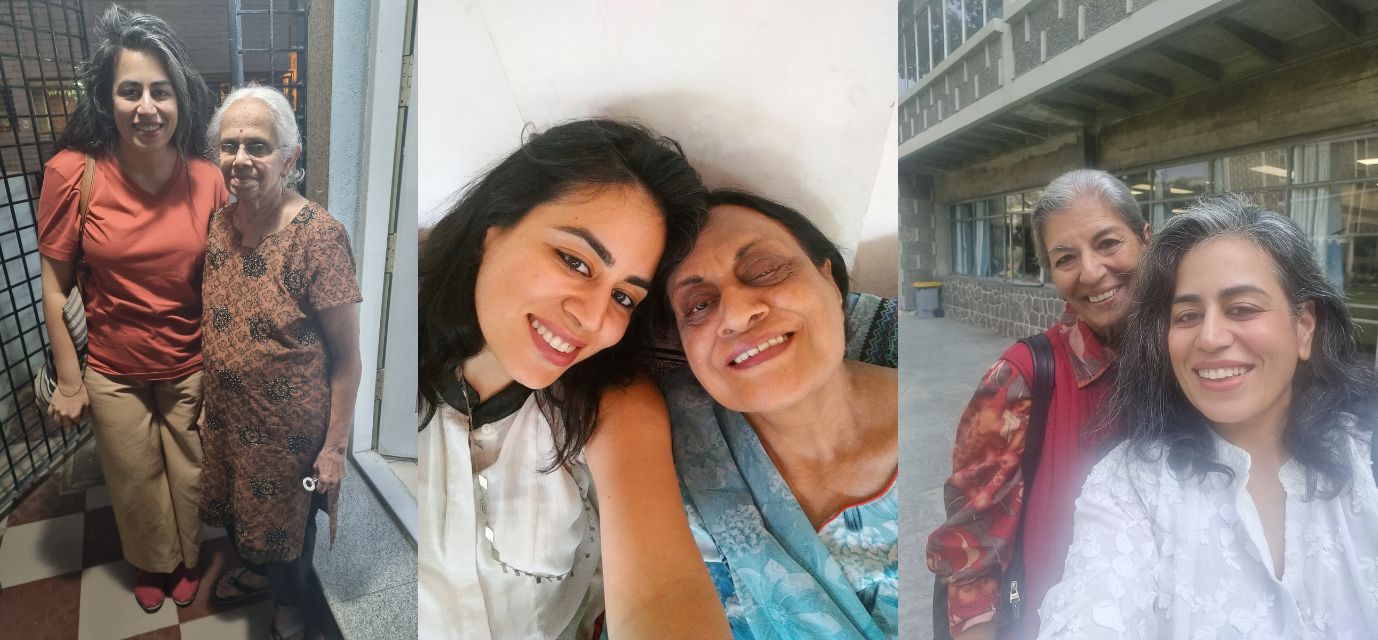
and Gita Prakash, doctor turned fashion model
T: How did you select the final 12 stories?
JMK: Initially I did calls with the kids and grandkids who had nominated their grandmas, because the women themselves would usually respond like, “What’s the big deal in what I did?” Many didn’t even identify as feminists. Once I got through those hundred names and knew I was writing a book, I hired my research assistant Priyam Moonka, and we started thinking of ways to find more grandmothers. We looked for women who might have already been featured in the news, if not national then local. Then we found Bullet Nani [Raminder Dhillon] through her TED Talk with Shah Rukh Khan. I knew that since these video shoots have time limits, there would be more to her story.
T: What were some of the challenges you had to face while working on the book?
JMK: I started writing this when my son was two, and the book was published after he turned six. And in between, I had to find a new publisher for the book as well. So I needed a lot of internal motivation to not abandon the project. And it was the grandmas that gave me that motivation, so whenever I got close to them, I would actually ask them, “How can I juggle all of this?,” and they would tell me I was on the right track, and I just needed to keep doing what I was doing.
T: Did you get to try any cool things while interviewing these cool grannies?
JMK: I’ve written about how Meenakshi amma [Meenakshi Raghavan, a grandma who has been practicing kalaripayattu since she was seven years old] made me pose with the weapons while I was there. I was giggling the entire time and she would keep telling me to stop smiling, “You have to look fierce!”. When I met Dr Rahmath Beegum [the first female doctor in the Lakshadweep islands], she fed me Lakshadweep-style biryani; the IPS officer Sridevi Goel offered me a gin and tonic and I gladly agreed, wanting to loosen up and have a frank chat. One of them even took me shopping and bought me a Kerala-style Kasavu saree. I’ve spent so much time with them, and that’s actually why I still feel close to them. I wish them on New Year’s, Diwali and on their birthdays.
T: Which story surprised you the most?
JMK: I think Pavane Mann’s story, of doing a round-the-world trip at the age of 54, and having a romantic fling on every continent. She made me question my ideas of what a grandmother should or should not do and I loved that. Why can’t a grandma have sexual revelation or learn to value her attractiveness? I asked her, “Did you never feel judged by everyone around you?” She said, “Everyone knew how I was, so they didn’t bother to bug me with judgement.”
T: Was there a common theme or trait you found in all these grandmothers’ stories, other than their candour or courage?
JMK: Resilience for sure. They were the OG hustlers. They had to become good at overcoming obstacles since there was no other way to live life on their own terms. And they did it with a lot of grace and patience—most of them weren’t even resentful if someone did them wrong. When I would do the interviews, getting them to dwell on the negative parts was hard. In fact, I felt like they had almost developed positivity as a coping mechanism.