


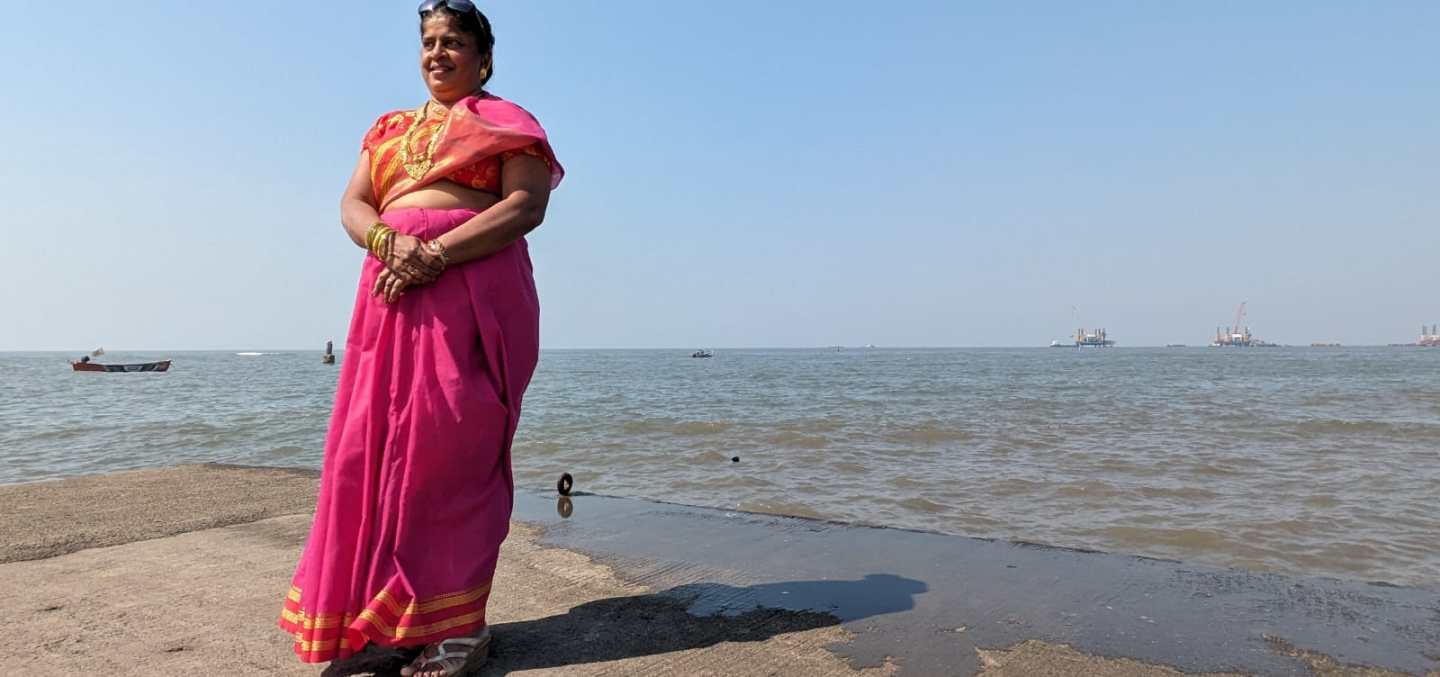
How Thelma Falcon-Poojari became this Bandra village’s pluckiest guardian
The fight for Chimbai starts with fugias
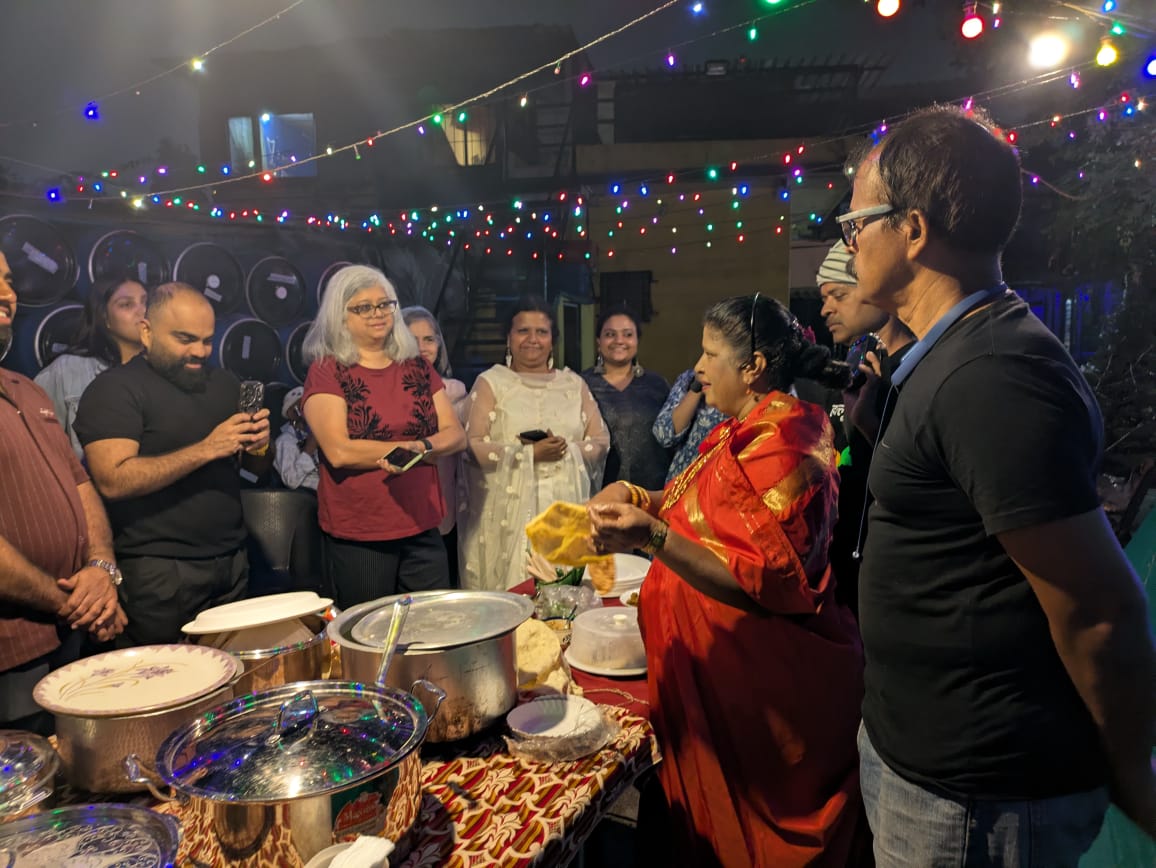
When Thelma Falcon-Poojari steps out of her home to greet me, I do a double take. I met her for the first time only two weeks ago: her house in the village was the last stop at NorBlack NorWhite’s Chimbai walk, led by Aliya Khan and Tanvi Mehta. Then, Falcon-Poojari was decked in a red sari, confessing she had needed two people to help her with the traditional East Indian drape. Red and yellow flowers poked out of her juda, multicoloured bangles clinked on her arms as she handed us small packets of marzipan and fugias, both traditional East Indian desserts she had prepared herself.
Now in a loose top and jeans, the 58-year-old looks like a different person. She is more relaxed as she guides me to a bench on her concrete porch: Falcon-Poojari’s home is, to put it crudely, prime Bandra property. Behind her, the Arabian Sea crashes into rocks and a breeze messes up our hair. Her puppy Nico nips at my feet every few minutes. It is hard to believe this woman–so warm and generous, constantly flanked by two senior dogs–is Chimbai village’s boldest warrior.
Belonging to one of the oldest families in not just this village but possibly all of Mumbai (to put things into perspective, her ancestors have been here for 400 years, even before the Taj Mahal was constructed), Falcon-Poojari is now fighting the many powers attempting to push Mumbai’s original inhabitants out of their homes, and in the process, destroying cultures and livelihoods already on the verge of extinction. Surprisingly, being the unanimously christened chairman of the only fishing village in Bandra is just one of the many things on the multi-hyphenate’s CV: her catering business preserves the East Indian food culture, her clashes with authorities are endless, and her day job includes working with Lonica Undertakers. There is never enough time to enjoy the sea view.
Chimbai calls
“This place was like Juhu Beach, there was sand everywhere,” Falcon-Poojari signals towards the rocky shore behind her, recently declared Mumbai’s dirtiest beach. She fondly recalls the village feasts they used to have by the sea about four decades ago, the Dharmendra and Amitabh Bachchan films they’d watch on a projector, the games of chor-police and lagori she’d play with her friends. As encroachments grew, the sand was removed for human activity. The plastic and garbage which washes ashore is now stuck in crooks and crevices of rocks. As a result, fishermen have to go deeper into the sea and use an increasing amount of resources to find the same amount of fish.
Then in 2019, came another hit: the first battle Falcon-Poojari led against the authorities. “I was in my house when I heard loud noises,” she remembers. “I came out to see big bulldozers and cranes pulling out the rocks on the shoreline. Huge black, yellow rocks that were more than a million years old. None of the other villagers came out.” Ecologically, this rock armour is significant, protecting homes from coastal flooding. “By the time I got there, they had already pulled most of them out. I told them to stop immediately. When they didn’t listen, I went straight on the cranes.” Despite being threatened, nearly arrested and more, Falcon-Poojari filed a petition–alone–in the Pune environment court. She won, but it was a bittersweet victory. “Every year, we have a storm in July and the seawater enters our homes,” she shares. “It used to be two feet, three feet. This year, it was six feet. We can hardly sleep in the monsoons.”
The stunning view from her porch is obstructed by the Coastal Road Project, which has drastically harmed fishermens’ livelihoods. In return, she says, the government has promised paltry amounts as compensation–and refuses to share construction plans with villagers so they can learn how their homes will be affected. This is not all Falcon-Poojari is protesting against: there are also attempts to reclassify Chimbai from a gaothan (a historic village) to a slum, so this land can be redeveloped and sold to private investors. There are rumours of a road that may cut through the neighbourhood.
Falcon-Poojari is wistful: “In the next ten years, most of this will be gone.” But community sustains her: she is no longer alone in her fight. “I tell the youngsters: this village is not mine. I am here for how many years? After that, it’s all you. You need to love the village, the sea.”

Food for thought
From plum wine to vindaloo and marzipan, Falcon-Poojari’s catering menu includes an array of traditional East Indian food options. At the end of the Chimbai walk, after we’ve munched on our fugias–sweet, fermented bread balls–she points to the other items on the table: non-alcoholic wine, two kinds of pickle, a book filled with East Indian recipes and another about East Indian culture. The wedding pickle, she tells us, is a sweet and sour mixed fruit-and-veg pickle made by all of the village’s women together for special occasions.
This food is another reason why I am excited to meet her again: my first jar of wedding pickle was wiped clean by my family and I in less than two weeks, and I have not stopped thinking about the fugias since I first had a bite. Cooking, to Falcon-Poojari, is not a relaxing hobby but another job. “My friends say come, we’ll celebrate Christmas, we’ll go for that party but I always have orders,” she shrugs. “No time for chilling.” She quickly packs me another jar of wedding pickle, and I order a kilogram of fugias she promises to prepare by Saturday.


To be a fighter, I realise, does not mean to be cold, vicious. Quite the opposite: Falcon-Poojari is someone who cares, feels deeply–and will go to any lengths to protect what she loves. She is not someone who wants to be in this position but someone forced to stand up for her community. “You have to love your village, where you’ve grown up,” she insists. On Saturday, I return to her home for the third time in a month to pick up my order of fugias. Just as I am leaving, I am called back, handed another bag: “Extra for you.”