



“They don’t see the courage it takes to be a bald bride”
27-year-old Mahima Ghai on challenging the notions of beauty
On my wedding day, I stood on stage in my heavy bridal dress with flawless makeup and completely bald.
Many guests and family members said, “Everything was so beautiful. You could have at least arranged for a wig.” When pictures from my wedding started trending on social media, many people were appreciative, but some comments were horrible. They said that women used to shave their heads when their husbands passed away, and others said I should have worn a wig.
They don’t see the courage it takes to stand on stage as a bald bride, and go through all the events of your wedding looking like this. But this moment, standing there with my head held high, was the culmination of 27 years of struggle and pain.
How it began
When I was around two years old, I was diagnosed with alopecia, an incurable autoimmune disorder. Since childhood, my parents have always been worried about this. While hair loss might be overlooked in boys, society judges girls far more harshly for it.
My parents began taking me to doctors and we tried ayurvedic treatments for several years. Hair did grow, but my body would eventually become accustomed to each treatment, making it ineffective.
Then came allopathic treatments. Doctors worked to develop hair follicles, which meant 300 injections in my scalp every single week. I was in the 8th standard when this began, and it continued through the 11th standard. My hair grew back completely, but when the dosage was reduced, it fell out again. The side effects were devastating: I ballooned to 110kgs, developed stretch marks across my body, and suffered severe hormonal imbalances.
Next, we tried homeopathy. By then, my body rejected everything. I had hair on only half my head. Distressed, I started shaving my head and wearing a wig to school in the 12th standard.
Finding my path
That was a very tough year for me. I was depressed throughout this time, and I told no one, I never sought counseling. I kept asking myself, “Why me? Everyone else is fine.” Even within my family, everyone has beautiful, thick hair. We’re Punjabi, and you can imagine the kind of luxurious hair most Punjabis have.
I can never forget the stares, the laughter, the teasing. These things still happen, but now I’ve learnt to ignore them. Sometimes I get angry and yell back, because this is my daily reality.
Despite everything, I excelled at art. Painting and doing crafts were my passions. After much convincing, my family agreed to let me pursue a Bachelor of Fine Arts in painting in Indore.
The move wasn’t easy, but painting soothed my mind and pulled me out of depression.
Then came an incident that changed everything. I was performing in a play when a classmate was supposed to place a garland on me. By mistake, she pulled off my wig in front of all my seniors and classmates.
I immediately grabbed a dupatta, ran to the washroom, and stayed there, terrified of everyone’s mockery. I only left after nearly everyone had gone, then cried my heart out back at the hostel. I’ve never told my family about this. That day, I realised: this was an accident, but someone could do this intentionally anywhere, anytime. I needed to become strong.
How I met my partner
Things continued this way for a while, then I met Shashank. I used to take portrait commissions, and he placed an order, and we started talking. I told him I had alopecia and that it wasn’t curable.
Gradually, we committed to each other. That was eight and a half years ago.

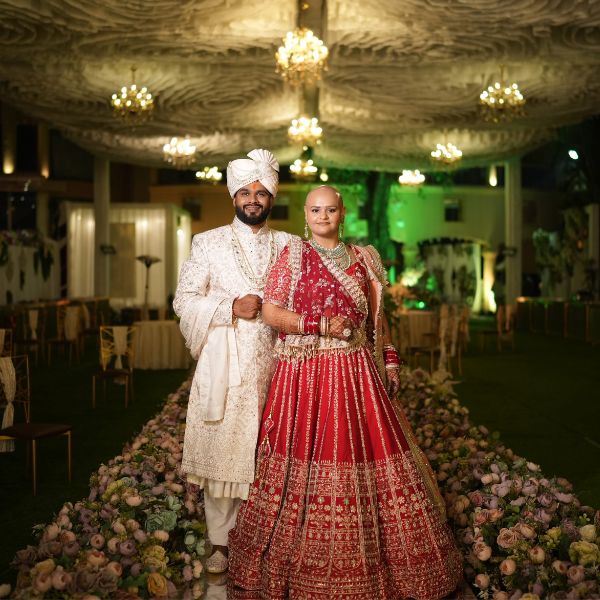
Meeting Shashank taught me that someone could love me exactly as I am. He helped me grow mentally and questioned why I wore a wig when it caused so much trouble. Wearing a wig for 10 hours daily was torture, the tight headband needed to keep it secure gave me headaches, made me sweat profusely, and created an awful smell and itching. The little hair I’d managed to grow was also being damaged.
By then, I’d stopped all treatments. We’d spent lakhs of rupees, yet no doctor had told me alopecia was incurable. Back then, we barely used phones or the internet, so I couldn’t research it myself. After moving to Indore, I did extensive research and learned the truth. I changed my lifestyle completely. In nearly two years, I dropped from 110 kg to 78 kg. My health improved dramatically, my hair grew back, but then it fell out again. I was devastated, especially since during those two years, I hadn’t eaten a single biscuit or any junk food.
Around this time, Shashank suggested that I stop wearing the wig and wear caps instead. They’d be easier, he said. My hair had grown back, but wasn’t thick on top, and a cap would conceal it. Today, I probably own around a thousand caps—almost all gifts from him.
When I had to travel or go out, I’d also wear a scarf.
The day I shaved my head
When I moved to Bengaluru for my master’s degree, my health deteriorated there because the food culture was completely different. My hair loss accelerated. I wore a cap even while working as a professor at the college, but the hair loss became so severe that bald patches showed through. I was extremely worried.
I decided to return to my hometown, Raipur, where I could focus on my health. I was so distressed about my hair that I thought: I should just shave my head. I had so little left, just the small patches you see with alopecia. I reached Raipur and shaved my head the very next day.
It felt strange initially, but then I accepted this was how I’d be. My mother hoped regular shaving would encourage regrowth. It hasn’t, to this day.
The road to the wedding
Relatives started telling me to wear a wig, asking why I wasn’t wearing one. During all this, Shashank and I decided to get engaged, addressing the question in everyone’s minds: Who would marry me? Would I be betrayed in a relationship?
Even then, many family members urged me to wear a wig. But not once has anyone from Shashank’s family mentioned it.
Behind all of this, Shashank has helped me develop mentally. The fact that I can stand confidently today and share my story, that’s all thanks to Shashank.
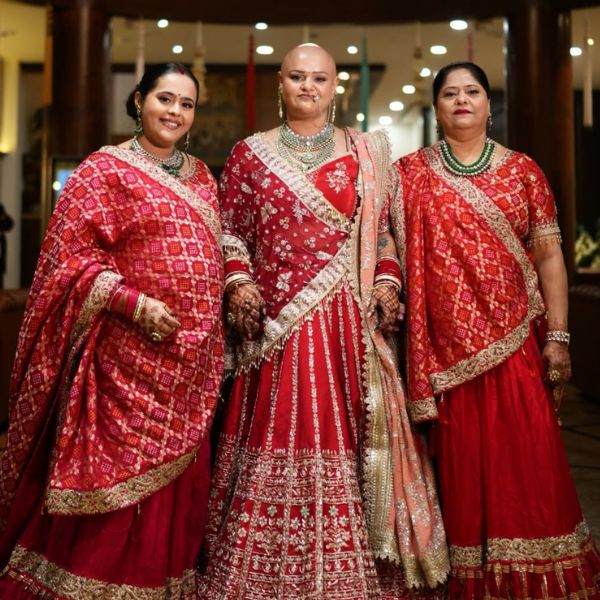
In my family, apart from my sister and mother, I haven’t received much support. At some point or another, the topic of covering my head or wearing a wig has always come up.
But I’m mentally strong enough now to know how and to whom to reply.
My statement to the world
I pray no one else faces what I’ve endured in these 27 years. I’ve come this far through immense difficulty, determined to live with my head held high and go anywhere I want. Yet even on my wedding day, people told me to wear a wig.
There’s nothing wrong with wigs, but wearing one completely changes my personality, and I’d constantly worry about it falling off. More importantly, it wouldn’t be me.
Standing there as a bald bride was my statement to the world: I am enough, exactly as I am.
And I can say this with complete certainty: even if God offered to give me my hair back, I don’t want it. I look beautiful without hair, and this makes me different from everyone else.