
3 Truths I desperately needed to hear as a jaded Zoomer
An afternoon of listening to poet Javed Akhtar, actor Ratna Pathak Shah and author Jerry Pinto eased my existential dread
Mid-twenties are truly a contradictory time. This is the most autonomy I have ever had, and yet I can’t seem to enjoy it. I am constantly worried about my parents’ health, if I’ve eaten enough protein, if my crush has viewed my story, if it’s time to invest in SIPs or if I should continue to treat myself for every little win because who knows where this world is headed? As I swirl in my day-to-day chaos, the weekend comes with the surprise that my friend has just broken no-contact with her bald ex for the third time because of the Venus retrograde.
With any and all information we could ever need readily available in a little square in our pockets, one would assume that 20-somethings today would have figured out a way to be more comfortable in our lives compared to previous generations. But somehow, we’re more bewildered—and struggle to imagine the future because everything keeps tilting all the time.
To escape all this overwhelm and uncertainty one Friday afternoon in late October, I made my way to the Godrej Literature Live! The Mumbai LitFest at NCPA (National Centre of Performing Arts) in Mumbai. I have always felt comforted by books and I hoped that would be the case again.
It was a sweltering day, yet even in that heat, the festival’s main area buzzed with readers stuffing their totes with new books. I had decided to attend the inaugural conversation between Javed Akhtar and translator Sumantra Ghosal at the Jamshed Bhabha Theatre, and a talk between veteran actress Ratna Pathak Shah and author Jerry Pinto at the Godrej Theatre. And I’m so glad that I did!
All three of them spoke about different aspects of being alive today—the different ways we see the world, the problems we face or create for ourselves—with such insight and humour that they left me feeling a bit more hopeful by the end of the evening. Here are the lessons I took away in case you’re a twenty-something sitting at home moping about where your life is too.
3 truths to soothe your jaded Gen Z heart

Truth # 1: “Information is not knowledge” – Javed Akhtar
Akhtar was there to launch his new book Three Masters, a collection of his favourite dohe by Kabir, Rahim and Vrind. The book features Akhtar’s annotations and explanations of the dohe and their English translations by Sumantra Ghosal. Ghosal and Akhtar spent the session ribbing each other as well as reciting a few of their favourite verses for us.
This particular doha by Kabir stood out to me,
कबीर सो धन संचिए, जो आगे को होय ।
सीस चढाए पोटली, ले जात न देख्या कोय ॥
Akhtar explained, “There are essentially three tiers: information, knowledge and wisdom. When you digest information, it becomes knowledge. Then you digest that knowledge and once it turns into the blood in the veins of your intellect, that is wisdom.”
It made me think about how with AI summaries and the rise of intellectual influencers who pre-digest cultural topics and classic novels into five easy bullet points, we’re not actually exercising our own mental faculties. And therefore not giving ourselves a chance to build deeper knowledge that can only come from doing the hard parts.
Akhtar added that even after you do gain knowledge and conviction, sometimes others might question it and “that will make you doubt what you know,” which is a good thing.
My takeaway: It’s okay to not know something or to change your mind when new information comes; the problem arises when you are unwilling to doubt yourself. Take your time to process what you know and question its validity.
Truth # 2: “Nostalgia only shows you half the picture” – Ratna Pathak Shah
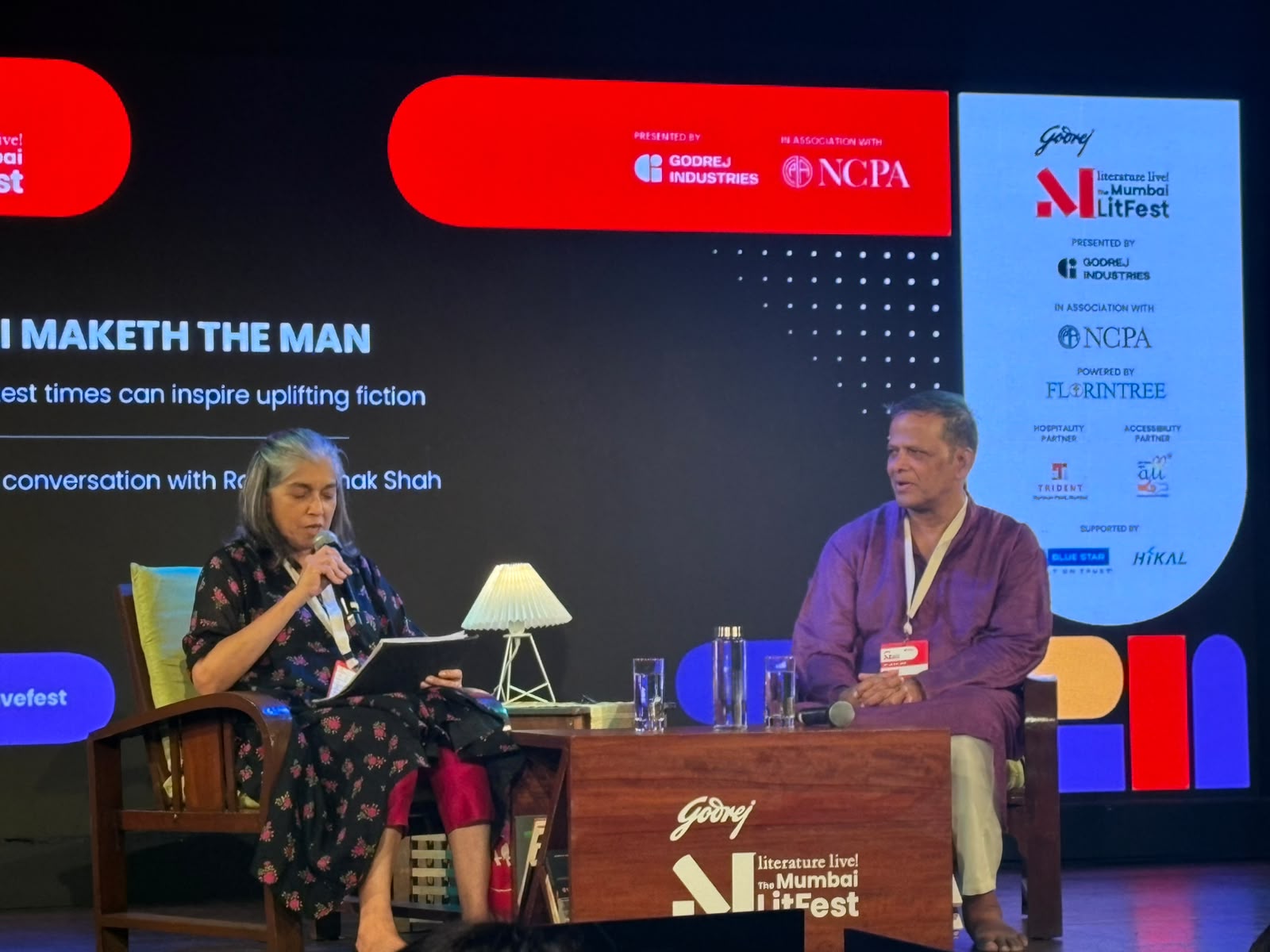
Ratna Pathak Shah and Jerry Pinto were there to talk about Pinto’s new book Yuri and the City, a sequel to his 2022 book, Yuri’s Education. While the first book followed the protagonist Yuri’s life as a college student, the sequel is about his time as a young journalist during the 1992 Bombay Riots.
Shah and Pinto reminisced about their days at Elphinstone College in Bombay in the 80s. They discussed how tempting it is to view the past from the lens of “the good old days”. Shah said she found it interesting to observe that Gen Z is often given to nostalgia too, especially for a time when their parents’ or grandparents’ were young i.e. a time they hadn’t lived in themselves.
In my mind I retorted with some defensiveness, “It’s easier to escape to a certain past than an uncertain future.” Then Shah went on to affirm exactly that feeling. “I get it. Being Gen Z—being young today—is a lot. I wouldn’t be able to deal with that, especially living with social media.” But she cautioned how nostalgia can be a double-edged sword because it only shows you how good things were, and glosses over what was bad.
She used the example of Gen Zs’ romanticization of old movies like Chashme Baddoor (1981). “They love the romance shown in it—they think that was our reality. But this courtship between men and women was a fantasy for us too. Our lives weren’t like the movies of our time.”
My takeaway: Maybe each generation goes through its own version of dread and pining for what they believe was a better past. But instead of trying to recreate something that supposedly existed before, maybe we should focus on preserving the good parts of being alive and young today. Like, I’m one of the first women on both sides of my family who has been able to pursue a career without worrying about my marriage prospects or children. And if I could just let myself see that, maybe I’d actually be able to enjoy this freedom more?
Truth # 3: “Writing and literature, no matter how dark, is about hope” – Jerry Pinto
Pinto’s writing exposes human behaviour in all its truth and ugliness in a way that leaves no space to hide behind words. Shah asked him whether it’s hard to write about the “bad stuff” and whether it affects his ability to have hope.
His answer really moved me: “…no writer, however nihilist, Beckettian, Godot-esque, Sartre-esque, ever gives up hope. When there is despair, when there is anger, and there is darkness in the author’s writing, it is because the writer feels that by talking about it, perhaps we, as readers, will all do something about it.”
When I interviewed Pinto post the session, I asked him if he thought there’s a way to stay aware of everything that’s happening around us but still keep moving ahead with our lives.
He reminded me that at the end of the day, everyone suffers, whether or not you’re living through “interesting times” (a reference to an old proverb that means living through major historical changes). “Anyone who looks like they are not suffering—they’re just better at pretending.”
My takeaway: In a very happy sense, my despair is not unique to me. The only thing I can do is turn to the arts, as humanity has done time and time again to make sense of it.
I left NCPA that evening somehow reassured that everything will be okay, at some point even if not right now. I felt reinvigorated by the words of these creative elders. It was similar to the jolt I experienced when I was introduced to Albert Camus at 18, and read “live to the point of tears” for the first time. Maybe I need to let my bestie go through her bald-ex phase after all.