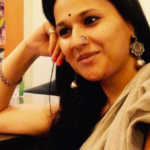


The only way to disarm poet Meena Kandasamy is by asking her to tell a funny story
In our new series Leading Ladies, we profile change-makers whose pursuit of excellence and challenging of conventions has inspired many to speak their minds
Meena Kandasamy wields the pen like a lightsaber. As a poet, author, academic and activist, words have shaped her craft. And yet, when it comes to her child, her storytelling abilities vanish into thin air. “We’ve become so politicised as people that we’re incapable of telling a random funny story to our five-year-old,” she says. “My kid wants to listen to a funny story at every meal. Just the other day, I was telling him about the conflict between the government and farmers, and at one point he asked, ‘but when is the funny part coming?'”
Even without the laughs, Kandasamy is an undeniable trailblazer. Her sharp, incisive writing is brave in its choice of subject matter, dismantling the status quo while articulating uncomfortable, almost taboo, realities. From domestic violence and caste-based atrocities to the subjugation of women and LGBTQIA+ communities, Kandasamy has uncovered and called out multiple forms of oppression. And while feminist and political rage fuels her writing, there is love, too. Except when Kandasamy writes about love, it’s raw and soul-piercing. Even when placed beside her politically-charged narratives, the love poems don’t feel out of place. Instead, they appear to be her sanctuary as she observes and tries to make sense of the injustice around her. In her latest book of poetry, Tomorrow Someone Will Arrest You, she writes about the arrest of her friends:
“Tomorrow someone will arrest you, your partner, your
children, your children’s children. Some measures are
essential to keep a democracy alive.
Long Live Silence.”
As a review published in The Guardian describes it, “Kandasamy’s writing is fierce and direct in its criticism of this deadening, suffocating silence, and those in power who perpetuate it. These vital, beautiful poems burn with a radically illuminating rage.”

Kandasamy’s origin story as a poet
Kandasamy, who turns 40 this year, was born and raised in Chennai, in a household where both academia and activism were very much in the foreground. Her parents’ marriage in 1981 was considered anti-caste, and Kandasamy grew up watching them contribute to the anti-caste struggle in significant ways. This early exposure indelibly shaped her work, and her politics.
In 2001, at the age of 17, Kandasamy published her first piece of writing, an essay that critiqued VS Naipaul’s Nobel Prize win, on the Postcolonial Web website. This was also the year she began editing The Dalit, a bimonthly publication that recorded experiences of caste-based atrocities, and documented the community’s heritage.
As part of her job, Kandasamy would attend the people’s court, where she witnessed first-hand accounts of the oppressed. These experiences affected her deeply, and also shaped her writing career. “I felt there are so many bad things that are happening, but I found the language of reportage very limiting, and realised that it can’t be emotionally charged. I had to find a place to put all my anger and feelings, and I found that space in poetry,” she says.
After renowned Indian poet Kamala Das took notice of her work, Kandasamy published her debut poetry collection, Touch, in 2006, at the age of 22. Since then, she has released three more poetry collections, as well as three novels, most notably, When I Hit You: Or, The Portrait of the Writer As A Young Wife (2017), which is based on her experience in an abusive marriage. The novel was shortlisted for the Women’s Prize for Fiction in 2018. Alongside her literary career, Kandasamy has written impactful non-fiction work, like the 2021 book The Orders Were to Rape You: Tigresses in the Tamil Eelam Struggle.
I have no regrets, but I did learn my lessons the hard way. And at some point when people realise that you’re not the kind of person who listens to others, they refrain from giving advice.
Meena kandasamy
Leading change through words
Writing on sensitive and divisive issues like caste and gender is bound to cause some amount of backlash, especially when there are powerful political and social forces working against you. Ask her if she was ever advised to reconsider her choice of subject matter, and Kandasamy replies, “I’m slightly foolhardy and I like to go into everything blind. I have no regrets, but I did learn my lessons the hard way. And at some point when people realise that you’re not the kind of person who listens to others, they refrain from giving advice.”
Having said that, with the wisdom of hindsight, Kandasamy does offer some advice to young students and women interested in activism—avoid getting involved in radical ideological protest without realising the power of the system you want to take on. “Personal experience is great but you have to also protect yourself,” she says. “You can do disclosure when you’re strong, established and have a community that’ll back you. If you get into disclosure and the idea of exposing somebody [or] fighting a system when you’re too young, too unprepared and vulnerable, I think the system can defeat you. So choose your battles wisely… until the balance of forces is on your side, be a little bit more cautious.”
Learning from emotionally-charged activism
Kandasamy’s inner circle swears by her easy-going demeanour, and she sometimes wonders when the disparity between her personality and her writing style grew. “Maybe my light-hearted personality developed because I write heavy; or I write on heavy subjects to disconnect from this very light-hearted approach to life, I’m not sure which way around it is,” she says. The mother-of-two also admits that at certain points in time, comfort, not agitation, is the need of the hour. Like the rest of us, Kandasamy also has a pile of abandoned projects, mostly because she didn’t want her writing to add to a collective feeling of doom. “What we need at the moment is a sense of optimism and hope, I believe,” she says.

When you’re deeply invested in emotionally-charged writing and activism, you’re bound to face moments of defeat. But three things keep Kandasamy going. One, is the realisation that her role is to observe and write, and that there are others who are willing to pay a much greater price than writing will ever demand from her. Two, writers live for long-term impact, for the future: “You don’t want anyone looking at your work 50 or 100 years from now to think that you were a chicken, or sellout of any kind.” The third is motherhood, and the desire to leave behind a better world for her children, in whatever capacity that she can.
Her fighting spirit also informs the way she deals with internet trolls, negative comments and hate. She believes in not taking things personally, and practicing detachment. “They don’t know you. All that they know is [that] you stand for something, and they don’t like that, they don’t understand it. So as much as the comments are very personal, they’re actually absolutely impersonal. They would say the same thing for anyone,” notes Kandasamy.
Chronicling a decade of change
Her latest poetry collection, Tomorrow Someone Will Arrest You, is a compilation of poems written at different points over the last decade. Some of these poems, which chronicle ten years of political and social change, were written in response to events like the 2018 violence in Bhima Koregaon, the protests around CAA (Citizenship Amendment Act) and NRC (National Register of Citizens) in 2019, and even the arrest of some friends. “In my head, I was never working towards a poetry book but…. I thought this was a very good juncture to put it together. [The collection] talks about how it has been witnessing the changing political and social landscape, and how the resistance keeps itself alive, where you find hope.”
For those inspired by her work, and looking to delve deeper into political and social theory, or just expand their worldview, Kandasamy recommends three books—The Argonauts by Maggie Nelson, anything written or theorised by Vladimir Lenin, but specifically his theories on the national question to understand identity, imperialism and capitalism, and Annihilation of Caste by Dr BR Ambedkar.