

Jewellery that fends off nosy relatives for you
Designer Eina Ahluwalia’s new collection defends your bodily autonomy
It’s 2026 and you can still hear a room go quiet the minute a woman says, “I don’t want to have kids”. A herd of aunties, uncles, bhaiya-bhabhis will run up to you like school children lining up for free candy. They’re ready to use all diplomatic tactics to influence you to join their gang.
“Bhudhape ka socho, kaun dhyaan rakhega?” (Think about your old age, who will take care of you?)
“What if your parents thought the same?”
“But, what else will you do? You’ll feel so empty later in life.”
Never mind, these exclamations come right after their long rants about the difficulties of raising children, exorbitant school fees and the unstable economy. You’ll still never be able to convince them to see your life from your lens.
In recent years, as we see a global shift towards conservatism—with the rise of the trad-wife in popular culture, many Gen Z wives and mothers are adopting traditional house-bound roles, having multiple children, all behind the safe cover of choice feminism—it feels even more important to defend one’s decision to be child-free.
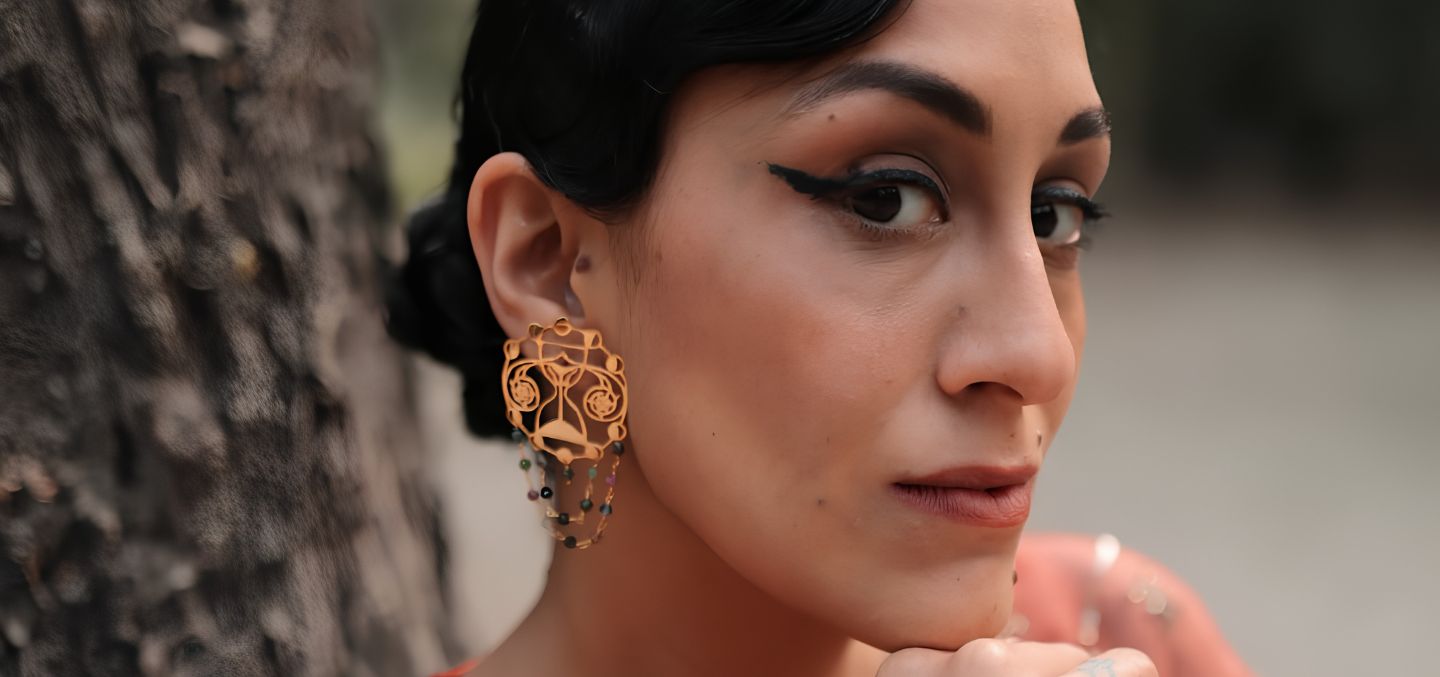
Jewellery designer Eina Ahluwalia’s new collection does exactly that. Called Labour, the collection speaks to the bodily experience of being female, the autonomy over our reproductive choices and women’s identity outside motherhood.
Designed by Ahluwalia, in her signature hand-cut style, these pieces are crafted by artisans in West Bengal, and are made from brass and silver. Her newest collection, titled ‘Labour’ was specifically designed for women who choose to be child-free. Based on her own personal life, Ahluwalia, currently in her 50s, has never married or had children.
Her jewellery designs have always stemmed from her observations, especially around women’s lives and troubles. This newest collection draws from themes such as a woman’s biological clock, bodily autonomy, and moving beyond the traditional belief that motherhood completes a woman.
We sat down with Ahluwalia to understand her motivation behind the collection, her brand’s unique motto “for the wise and wild” and her reflections on a child-free life.

Eina Ahluwalia’s jewellery collection is pro-choice and anti-judgement
Tweak: What inspired you to design your latest collection, Labour?
Eina Ahluwalia (EA): There are so many different kinds of labour that women do. From the primary labour [giving birth] to raising children, which includes emotional, physical and mental labour. If you’re lucky, you’ll have a really good partner and/or a supportive family on his side, but mostly it doesn’t happen.
Personally, I wanted to take the time to figure [what I wanted], and while I was waiting, all around me, I saw that raising kids didn’t actually look like a lot of fun. It looked like a lot of labour, and it seemed to serve everyone else but the women doing it. You look after your families, your husband, look after the house, the children.
People still coerce women and couples into having children as soon as they’re married. Why are we still hearing this? I thought we would have left it behind by now. And that’s why I decided to create this collection.
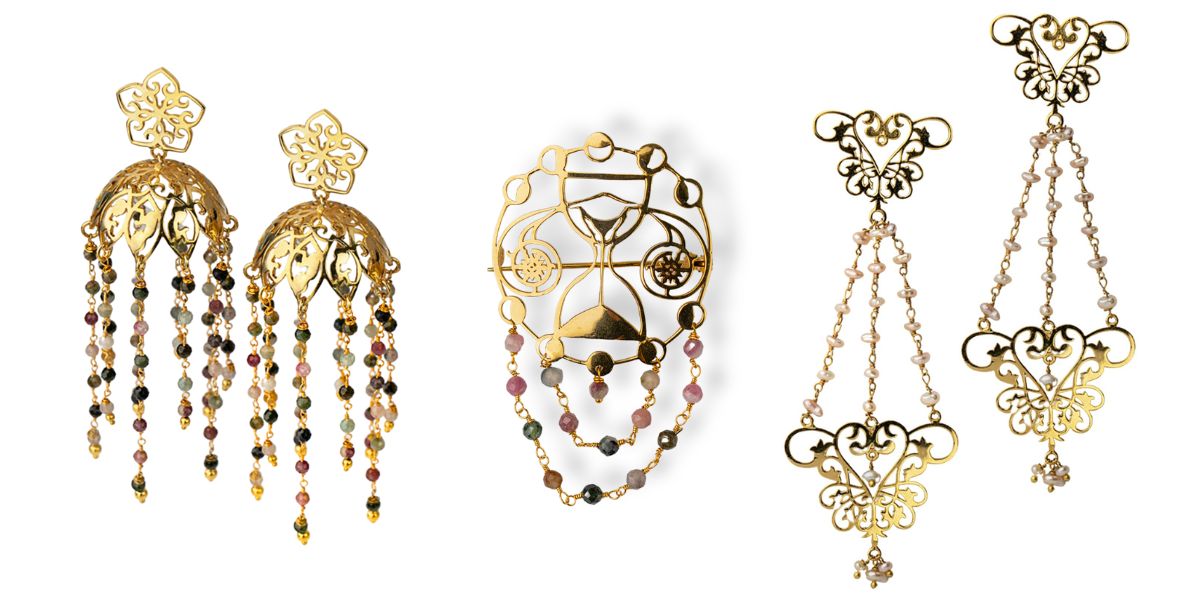
Tweak: Walk us through some of your favourite pieces from this collection.
EA: There’s one called ‘Birthing Babies & Revolutions’, which is about how women are capable of birthing babies and revolutions. It has a little hand-cut fetus motif on each piece of jewellery, but when you look at it from afar, it looks like a typical jhumka or necklace.
There’s another one called ‘Not Just A Baby Machine’ [a lariat necklace] that has a hand and a baby. It’s like the hand is always asking for a baby, but the baby is not happening.
The most personal one to me is, ‘This Bloodline Ends with Me‘. The design depicts a family tree that shows the lineage ending with one person.
Another favourite is, ‘Womb’, [a pendant] which was originally called ‘Get The Law Out Of My Uterus’ — it’s basically the uterus with the ovaries.
There’s also ‘For My Personal Pleasure’ which is yet to be launched, and the motif, it’s the shape of a yoni, but it looks very contemporary. It’s filled with flowers and beautiful patterns on the inside. [It signifies] how our bodies, our vaginas, or our sexual life are also for our personal pleasure, not only for reproduction. It’s about reclaiming our bodies and our sexual freedoms.
Tweak: What do you hope a woman feels when she wears a piece from this collection?
EA: I feel like women will wear it as a quiet statement or a quiet rebellion. It’s a message that only gets spoken about if someone asks.
Tweak: Do you think jewellery as activism actually changes minds, or is it more about affirming women who already feel this way?
EA: What I create is definitely political, and when I say political, I mean it has my ideologies built in. Anybody who wears it is wearing it with that knowledge, and therefore that’s a political act as well.
As far as activism goes, while it’s really important to go out on the streets and protest, and it’s really important to do everything we can to defend human rights, I think one must try and contribute in every way [possible]. So although this is just jewellery, it feels like a tiny way to make an impact. The jewellery sparks authentic conversations that fuel each other [the movement and art], and it is what we fuel each other with. We go back thinking, I’m not alone in this, I’m not the only one who thinks this is wrong.
Tweak: Why did you start designing jewellery?
EA: I had a degree in marketing and worked for four years. But I realised that I don’t want to wake up at 60 and realise that even though I made money, I have also lived a meaningless life. So I took a segue into craft and decided on jewellery because I enjoyed it, and it did not take up as much space.
I started the brand 23 years ago, but five years into the business, I began rethinking that vision because it felt like I was creating meaningless ornamentation. It made women feel beautiful, but that only happens when they don’t already feel beautiful. I didn’t want to fuel that insecurity. So, I began researching conceptual jewellery, which mixed both the meaningfulness of art and the wearability of jewellery.

Tweak: What does your creative process look like?
EA: A lot of it is personal, but it can also come through different conversations, engaging with other people and the world that we live in, too. When I choose a concept, it has to resonate with a lot of people. Once I narrow it down, I think about all the different things it could mean.
For example, with Labour, what kinds of labour are there? What are the different viewpoints? Like, I don’t want to have children, so my bloodline ends with me. I can give birth to children, but I also give birth to revolutions.
Then I figure out different motifs and the type of jewellery they can translate into. I look for new variants, but also the usual earrings and necklaces. We go into the sampling stage then, and sometimes the designs change a bit during this process.

Tweak: In a time dominated by fast-fashion, what is it like sustaining a brand that doesn’t mass-produce?
EA: There are brands mushrooming every single day, and all of it is jewellery mass-produced in China. Where is the craft in it? It’s fun to wear, and it’s super cheap, which is great, but it is meaningless and contributes to consumerism.
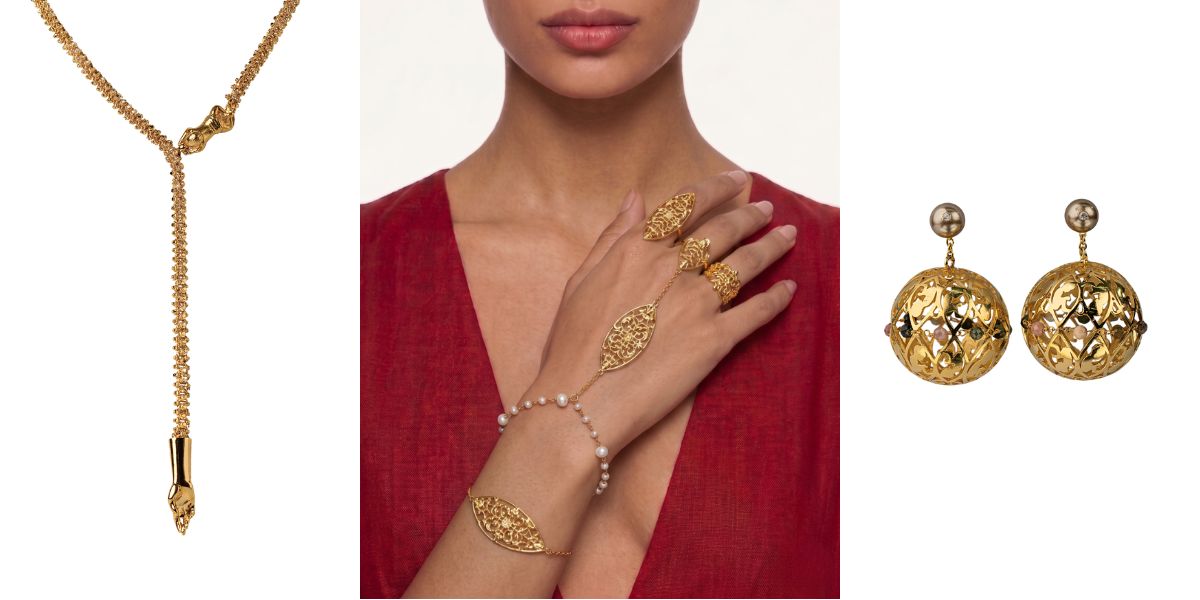
The jewellery I create is made by craftsmen in Bengal. All those jaali [fretwork] pieces that you see on our website, they’re not laser cut, they’re handmade and still super fine and precise. It’s because they’re cut using a saw as thin as hair. These artists have been perfecting this craft for generations.
Consumers are happy with the pace of fast-fashion, but that affects artisans who can’t continue practising this craft. My sister, who is the brand head, and I discussed mass-production but decided against it. We want to stick to our ideology and ethics. Our pieces are expensive, yes, but we can’t abandon the artists we employ either. It puts a cap on our growth and it’s a super niche market as well, but it’s the one I want to serve.
Some of our customers still wear designs I made 20 years ago. If the piece is well-made, honestly, it should last a lifetime, or at least decades before we need to help customers restore it.