


Meet the matchmaker for asexual Indians
A match made in heaven at Platonicity
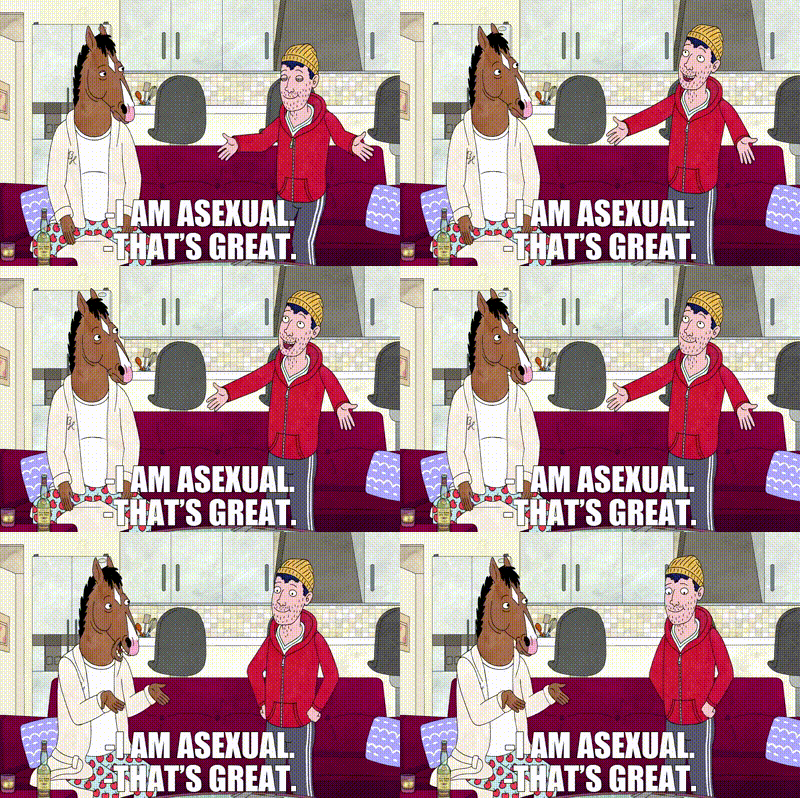
If you’ve watched BoJack Horseman, you might remember Todd Chavez, the quirky, lovable friend with bizarre business ideas like a theme park for ghosts. However, Todd’s relationship storyline takes an unexpected turn when his asexuality is explored in season four. In a quiet but significant moment, he meets Yolanda Buenaventura, an asexual character who asks him out. Todd gently explains his asexuality, and Yolanda simply responds, “I’m ace too. That’s why I’m asking you out.” Ace is a popular shorthand for asexual, and this scene subtly captured the complexities of asexuality in dating, offering an honest, drama-free moment of connection. It’s not a plot twist but just a part of who Todd is—much like it is for Dr Pragati Singh.
36-year-old Singh’s journey with asexuality began in 2013 when she first encountered the term ‘asexual’ while exploring and questioning her sexual identity. Intrigued and curious, the Delhi-based consultant and social entrepreneur dug deeper online to understand her own experiences. “I didn’t know any communities for asexuals in India. There would be some Italian group, and there’s always one Indian person asking in that group, ‘Is there anybody else from India here?’ Because there was nothing, nowhere else for them to connect.”
Recognising the shortage of information and support for asexual individuals in India, she took it upon herself to bridge this gap.
In 2014, she launched a Facebook page, Indian Aces, to create a safe space for asexual individuals to connect, share their experiences, and find a sense of belonging. This group quickly gained traction and is now a growing community of 4,000 members who were previously isolated and misunderstood.
By organising meetups and setting up a platform tailored to the asexual community, Singh is working towards creating a space where people who don’t experience sexual attraction can feel seen, understood, and—most importantly—connected.
We spoke with Singh to unpack the complexities of asexuality, talk about the importance of community, and dive into what it takes to get into matchmaking for the asexual (and more) community.
What is asexuality?
At its simplest, asexuality is the lack of sexual attraction to others. “It’s not about whether or not someone enjoys sex, it’s about not feeling sexually attracted to anyone,” Singh explains. “Being asexual doesn’t mean you’re celibate or that you don’t want sex—it means that you don’t experience sexual attraction.” It’s the kind of thing that often gets misunderstood, with people mistakenly thinking it’s just a lack of interest in sex, but it’s more nuanced than that.
Singh breaks it down with an analogy: “There are men who have sex with other men, but that doesn’t necessarily mean they’re attracted to them sexually. They might just be engaging in the activity. On the flip side, a gay man is attracted to other men. It’s the same with asexuality. You may still have the desire to engage in sexual activities, but the attraction itself just isn’t there.”
Asexuality is also a spectrum of experiences, adds Singh, with micro labels to explain (or better, understand) if someone is interested in dating, romance, and other forms of intimacy.
Building a community
Singh started organising meetups for members of the Indian Aces group, the first one being in 2017. These meetups quickly became more than just casual gatherings—they were a lifeline. “When I did the first meetup, I saw how many people had travelled to be there. It was clear how much the community was craving this,” Singh says. “People were looking for others who understood their experiences. It wasn’t just a social event. It was community building.”
This initiative quickly expanded with Singh organising events in 10 cities across India by 2019. But when the pandemic hit, things had to shift. “We went online during COVID, and while it was necessary, it was also a challenge to replicate the feeling of connection,” Singh explains. Still, the need for these spaces was clear, and the online events kept the community alive.
Soon Singh noticed a pattern: when people would meet through dating apps or at meetups, they often had to negotiate conversations around asexuality. In the regular dating world, the assumption is that everyone is looking for romance or sex. But for asexual people, a space was needed where that’s not the default. These spaces would be about finding like-minded individuals and not having to explain yourself all the time.
This observation led to the creation of something bigger—Platonicity.
Playing matchmaker
In 2021, Singh launched Platonicity, a matchmaking platform for those seeking connections without the pressure of sexual or romantic expectations. Think of it as a service designed to help people meet in a space where these dynamics are already understood. Singh explains that dating apps often come with “doubts before you can comfortably connect with another person because of the expectation of sex and romance. In this case, these things are already negotiated and taken care of by Platonicity’s one-on-one consultation, and hand-picked matches, so the pressure is off.”
The platform isn’t limited to the asexual community—it caters to anyone navigating the constraints of traditional romance, intimacy and relationship norms. In India, where marriage is a near-universal expectation, asexual individuals are often pressured into heterosexual unions (a rare few work out well), which can take a toll on their mental health. Singh highlights cases like asexual women who don’t desire sexual or romantic intimacy but feel forced into marriage by family expectations. For them, Platonicity offers options like “lavender marriages” to queer partners seeking similar arrangements. As Singh explains, “For an asexual woman who doesn’t need romantic intimacy, she’s nonsexual and aromantic. She just wants a partner so her family gets off her back. For her, a lavender marriage to a gay man can be a really great match.”
This approach isn’t without challenges. How does it work? Is it ethical? But in a society where opting out of marriage isn’t always feasible, platforms like Platonicity aim to help people find their best-case scenario, even within a limited pool of matches.
Singh shares that while she cannot disclose specifics due to privacy policies, the response has been overwhelmingly positive. Her message to anyone questioning their identity or considering her platform is clear: “Even when they think that in their own identity or micro-label, they might feel alone, but I’m almost 100% sure that even then, they are not 100% alone.”
Singh emphasises the power of showing up for those hesitant to take the first step. Whether attending a meet-up or joining a community space, she’s seen lives and perspectives shift. “I’ve seen people’s points of view and sense of self drastically improve even after just one meet-up,” she says, encouraging people to take the leap towards understanding themselves and finding their tribe.
Platonicity is running a membership-based beta program, experimenting with different approaches to matchmaking and community-building. You’ll find more information about their services on their website.