


From goldfish to elephant — experts share tips to improve your memory
If your mental hard drive needs a software upgrade
Memories capture moments that become the threads in our life’s tapestry and the heirlooms we pass on to the next generation. Sometimes, we get to choose what stays in our minds. Other times, you realise some have slipped through cracks you never noticed before. Cue to hounding Google bhaiya. Except it can be like that one dramatic friend who immediately jumps to worst-case scenarios. Forgetting things? It’s brain damage. Blurry vision? Cancer. These things are possible, but more likely you need to see an ophthalmologist and work on improving your memory.
In a world that moves faster than the Shatabdi on caffeine, our brains have been forced to become multitasking masters. We are constantly bombarded with information from every avenue and screen — notifications, emails, tweets (X posts? Xeets?) and more. Striving for memory improvement — whether for purposes of work, exams, or simple mental exercises to keep you on your toes — is like looking for a software upgrade for our mental hard drives.
Because, when faced with too much information, memory becomes like a leaky sieve. We’re not incapable of remembering; it’s more like our brains are screaming, “Hey, slow down! I can only handle so much.” In the digital deluge of information and trivialities, our brains struggle to retain what’s truly important.
To survive the present, find ways to navigate the daily tsunami of data, declutter mental space, and reclaim a bit of peace and focus that seems lost in the digital age’s constant buzz, many have embarked on this quest to boost their memory.
Studies continuously explore the impact of smartphones on memory and data recall, some citing a rise in digital amnesia with our reliance on phones to quickly look up something when we can’t remember. On the other hand, some say digital amnesia is overhyped marketing for companies trying to sell you products. While there’s more to life than pondering the name of the actor who played Son Pari, improving our memory is key to hold on to the stories and scenes we want in our heads, and hearts.
We turned to the experts to help decode our power centre, and how to keep it in shape.
A note of caution: This story does not include memory loss caused by disease and medical conditions. Please consult a trained professional to find a treatment plan that will work for you.
Improving your memory, the expert way:
How do memory creation and retention work?
The brain is a complex organ that people spend years studying and analysing. We asked Dr Amit Shah, consultant neurologist, SRV Hospitals, Goregaon, to explain how memory works as simply as he can.
“When we see or feel something, our senses send this to a part of the brain called the hippocampus. Here, the information is stored briefly. To keep them for longer, our brain strengthens the links between nerve cells. This strengthening, known as synaptic plasticity, means the connections between nerve cells get stronger,” he says.
“Remembering things often helps them stay in our minds. The more we think about or practice something, the more fixed it becomes in our brain, making it tough to forget. However, memories can change over time or be affected by later events.”
Our brain’s complex system helps us hold onto memories by capturing experiences, making them stick, and finally letting us recall them when needed.
Ageing affects the brain as well as the rest of the body, says psychiatrist Dr Ashutosh Shah, Sir HN Reliance Foundation Hospital, causing structural alterations in all main cell types in the brain.
Realistic tips to boost your memory retention and recall
Dr Ashutosh says that in the first decade of life (our developing years), a healthy diet and environment “helps maximise the brain ability with which they are born”. But there is no magic pill to enhance memory significantly. “Like many physical traits, memory is an inborn genetic trait.”
However, he adds that you can use some of these tips to try and maximise your existing brain abilities.
Regular mental stimulation
Papa was right about Sudoku all along. “Engaging in activities that challenge and stimulate the brain, such as puzzles, reading, learning new skills, or playing musical instruments, can enhance cognitive function and memory,” says Dr Amit.
That’s where hobbies come in, says Dr Ashutosh. “Having a hobby can contribute to brain health by enhancing cognitive reserve [The brain’s ability to improvise and find alternate ways of getting a job done, according to Harvard Health].” Hobbies can also serve as great stress busters because stress impacts memory too.

It’s never too late to pick up a hobby, and if you’re struggling to find one, we have some suggestions here.
Adequate rest
“Quality sleep is crucial for memory consolidation and cognitive function,” says Dr Amit.
He is backed by Dr Ashutosh, who calls sleep the ‘underestimated natural medicine’. He says it can especially help students — for them, 8-9 hours of continuous sleep, beginning 3-4 hours after sunset, on the regular is important for improving memory and brain health. For young and middle-aged adults, healthy night sleep is around 7-8 hours.
If your night owl tendencies are keeping you awake, you’re not alone. Have you tried CBD oil or turning your bedroom into a sleep sanctuary?
Memory-enhancing techniques
My Very Educated Mother Just Showed Us Nine Planets – the first mnemonic most of us learned while still struggling to remember the spelling of ‘mnemonic’. We may have dropped the P, but Dr Amit says that mnemonic devices, visualisation, and association are some of the most useful memory-enhancing techniques that can aid in remembering information more effectively.
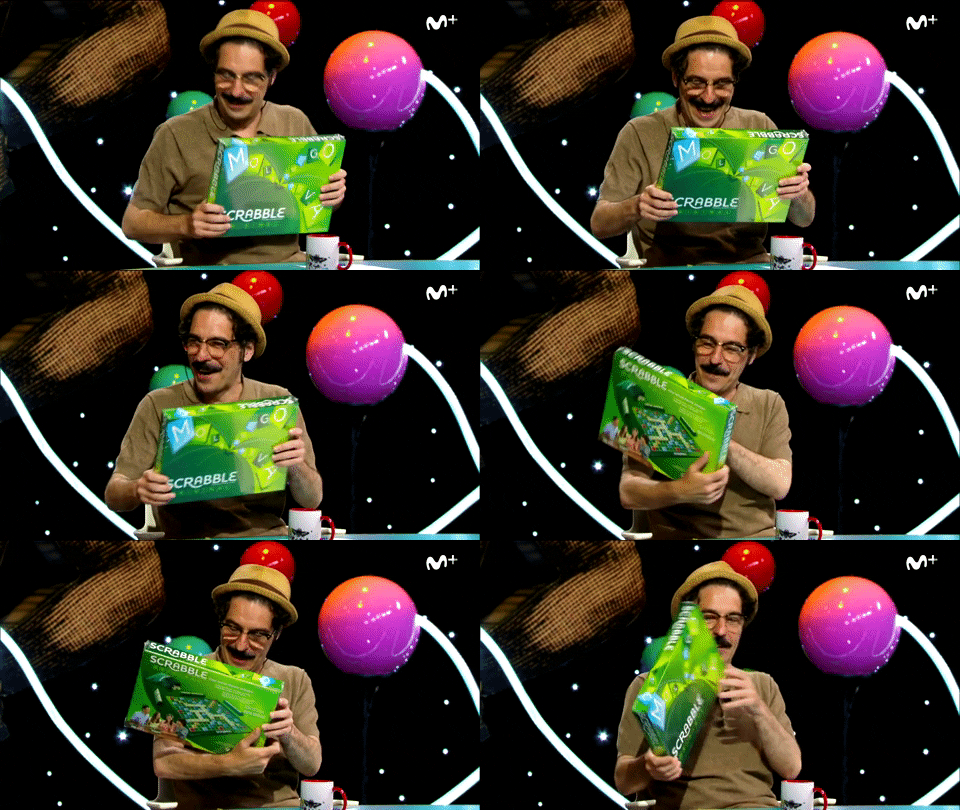
Crosswords, Scrabble, word and memory games challenge the brain and improve cognitive performance.
Another technique Dr Amit talks about is chunking. It might remind you of a KitKat, but it is like breaking down a big pizza into slices. Makes it way easier to digest, right? For example, dividing a 10-digit phone number into two groups of five or while making a list, pairing items that go together (ie. charger and mobile case, earrings and necklace, so if you remember one, you’re likely to remember the other).
Repetition is about reviewing stuff more than once, like rewatching your favourite comfort show. But here’s the twist: spaced retrieval is more like watching different episodes at different times. You watch one today, another in a couple of days, and then maybe a week later. Your brain loves this spaced-out refresher because it helps lock the info in for the long haul.
Physical exercise and the right diet
While we may have heard it more than the Dhoom horn on trucks, both experts say that regular aerobic exercise and a balanced diet rich in antioxidants, omega-3 fatty acids, and other nutrients support brain health, in turn, improving your memory.
We’re no strangers to gym jitters and found a few beginner-friendly and low-impact workouts you can try from home. For a newbie, more than the intensity of a workout, the focus should be on sustainability.
Intermittent fasting
Dr Ashutosh says that intermittent fasting of around 12 hours (from dinner to breakfast) can “have positive effects on brain and body health, and maximise one’s memory functioning and capacity.”
While research hasn’t been conclusive, one study proposed that intermittent fasting might help grow new brain cells in the hippocampus, the part of the brain linked to learning and memory. This could boost brainpower and lower the chances of diseases that affect the brain.

Another study suggests it improves cognitive abilities in older adults dealing with mild memory issues compared to those who don’t fast. Plus, according to this research statement, intermittent fasting seems to amp up the brain’s flexibility, making it work better and become more resilient against damage and illnesses.
Social engagements
Give in to the reticent inner social animal, as both experts explain that maintaining social connections and conversations keeps your brain young.
Think of hanging out with your friends like a mental gym where you flex those memory muscles. When you’re chatting, laughing, or debating, your brain throws a full-blown party.
You’re working out your brain’s coordination centre. Conversations, debates, and interactions keep those neural pathways firing, making them all strong and nimble.
Then comes cognitive reserve, the brain’s savings account. The more social connections you have, the more you’re depositing into this account. And when life throws memory challenges your way, this reserve helps you navigate through like a champ.
Socialising is like a vitamin boost for your brain. It pumps up your mood, lowers stress, and even helps stave off cognitive decline as you age. A Journal of Gerontology: Psychological Sciences report suggests that socialisation could “benefit older adults in warding off dementia, much the way physical activity helps prevent diabetes or heart disease.”
When information floods our senses, and memories seem as fleeting as Sunita’s latest Instagram story, our quest for improving our memory isn’t simply about remembering where we left our keys. It’s a journey of balancing: reclaiming control in a world brimming with data, carving out mental breathing space amidst the chaos. It’s about preserving the moments that truly define us and by letting some go, giving in to the messiness of being human.